
Technical Guide · Source Post 5403
How Does a Bowden Coupler Work? A Complete Guide to Push-to-Connect PTFE Fittings
Introduction A Bowden coupler is one of the smallest components in a Bowden extrusion system, yet it has a significant impact on printing reliability. Although it typically costs only a few dollars, a worn or improperly installed coupler can lead to a wide range of printing problems, including PTFE tube movement, inconsistent extrusion, filament jams, under-extrusion, and poor surface quality. Many users replace nozzles, extruders, or even hot ends when these symptoms appear, only to discover that the actual cause is a worn push-to-connect fitting. Because the Bowden coupler sits between the PTFE tube and the extruder or hot end, even slight movement of the tube can interrupt the filament path and reduce extrusion consistency. Originally developed for pneumatic systems, push-to-connect fittings were designed to hold flexible tubing securely while allowing quick installation and removal. In modern FDM 3D printers, the same mechanical principle is used to lock PTFE tubing in place while maintaining a smooth filament path between the extruder and the hot end. Over thousands of extrusion and retraction cycles, however, the locking mechanism gradually wears, making the coupler a consumable component rather than a permanent one. Understanding how a Bowden coupler works is therefore essential not only for troubleshooting print failures but also for selecting the right fitting, installing it correctly, and maintaining long-term printing reliability. In this guide, you’ll learn: What a Bowden coupler is and why it is important. How the internal push-to-connect mechanism works. Why Bowden couplers eventually fail. Common symptoms of a worn coupler. Practical maintenance and replacement recommendations.
What Is a Bowden Coupler?
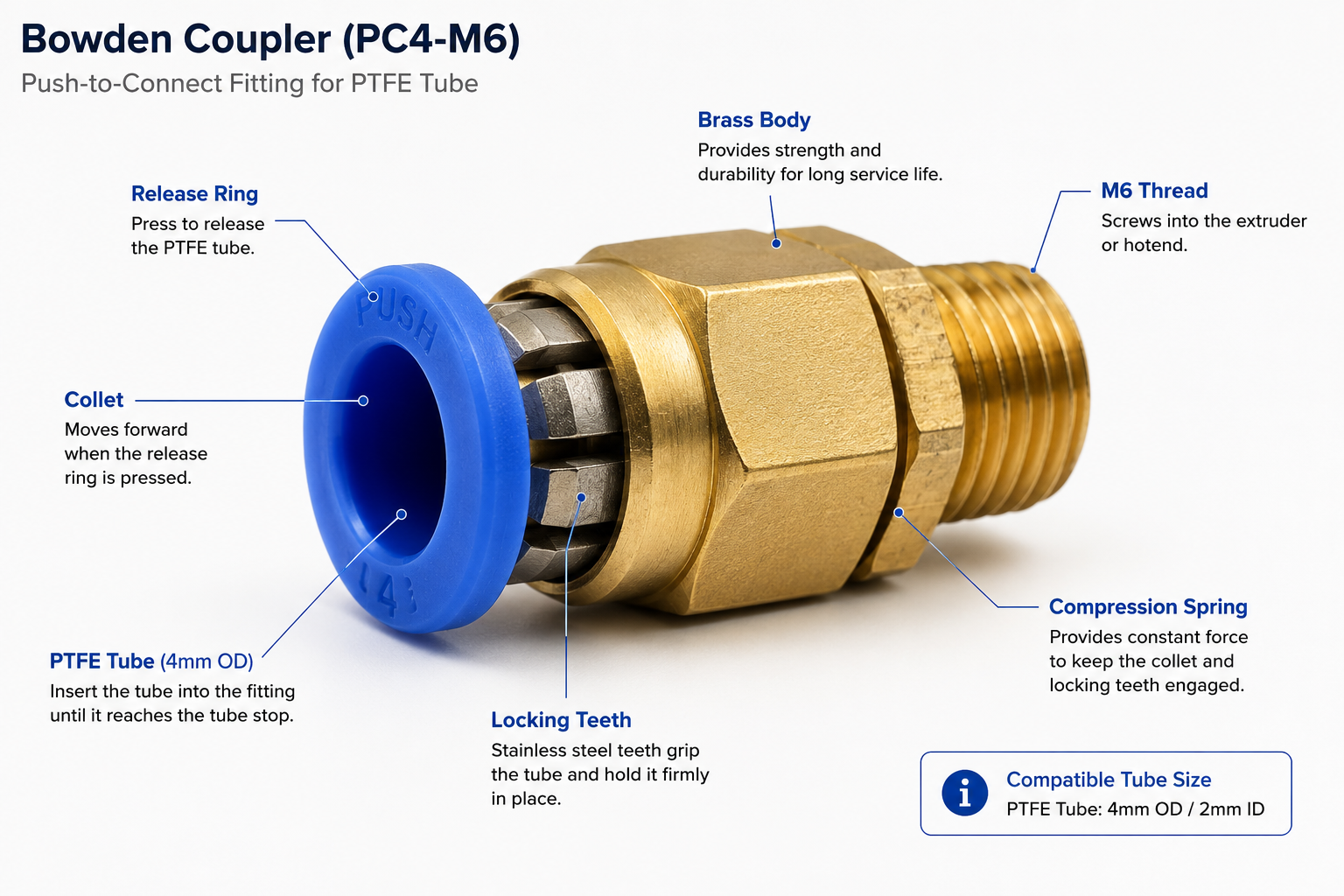
A Bowden coupler is a push-to-connect fitting that securely locks a PTFE tube while allowing the tube to be removed without cutting or damaging it. In 3D printing, the fitting is commonly installed on both the extruder and the hot end, forming the connection points of a Bowden extrusion system.
Unlike compression fittings that rely on threaded compression to secure tubing, a Bowden coupler uses an internal collet, stainless steel locking teeth, and a compression spring. When the PTFE tube is inserted into the fitting, the locking teeth automatically grip the outer wall of the tube. The harder the tube is pulled, the stronger the teeth engage, creating a reliable self-locking mechanism.
Because of this design, Bowden couplers are often referred to as push-to-connect fittings, push-fit connectors, or PTFE tube connectors.
A typical Bowden coupler consists of the following components:
- Brass body
- Release ring (collar)
- Stainless steel collet teeth
- Compression spring
- Threaded connection (such as PC4-M6 or PC4-M10)
These components work together to create a compact locking mechanism that allows fast installation while maintaining sufficient holding force during continuous extrusion and retraction.
Although Bowden couplers are widely associated with desktop 3D printers, the same push-to-connect technology has long been used in industrial pneumatic systems, automation equipment, and fluid transfer applications, where fast tubing installation and reliable retention are equally important.
How Does a Bowden Coupler Work?
The operating principle of a Bowden coupler is based on a simple but highly effective mechanical locking system.
When a PTFE tube is pushed into the fitting, it first passes through the release ring and then through the stainless steel collet. As the tube moves forward, the angled locking teeth temporarily expand to allow the tube to pass.
Once the tube reaches its fully seated position, the compression spring pushes the collet back into its original position. The angled teeth then bite gently into the outer surface of the PTFE tube.
At this point, the fitting enters its self-locking state.
Instead of relying on friction alone, the angled geometry of the teeth converts any outward pulling force into additional radial gripping force. In other words, the more the tube attempts to move backward, the tighter the locking teeth grip the tube.
This self-energizing mechanism is one of the primary reasons push-to-connect fittings have become the preferred solution in both pneumatic engineering and Bowden extrusion systems.
Removing the tube is equally straightforward. By pressing the release ring toward the fitting body, the collet is pushed forward, allowing the locking teeth to expand and release their grip on the PTFE tube. The tube can then be removed smoothly without excessive force.
While the mechanism appears simple, its performance depends heavily on several factors, including the quality of the stainless steel teeth, spring tension, machining tolerances, and the dimensional accuracy of the PTFE tube. Poor-quality fittings or worn locking teeth often lose their holding force, allowing the tube to move during printing and causing a cascade of extrusion-related problems.
For this reason, experienced users often consider Bowden couplers routine maintenance items rather than permanent hardware. Regular inspection of both the fitting and the PTFE tube helps maintain a stable filament path and reduces the risk of print failures.
Internal Components and Working Mechanism of a Bowden Coupler
Before diagnosing a worn Bowden coupler or selecting a replacement, it is important to understand how the internal components work together. Although the fitting appears to be a simple connector, it is actually a precision mechanical assembly designed to generate reliable tube retention while allowing quick, tool-free removal.
Unlike threaded compression fittings, which create holding force by mechanically compressing the tubing, a Bowden coupler uses a spring-loaded collet mechanism. Every component contributes to the locking process, and failure of any single part can reduce the overall holding performance.
Brass Body – The Structural Foundation
The brass body forms the outer housing of the Bowden coupler. It provides the threaded connection to the extruder or hot end while protecting the internal locking components from mechanical damage.
Most desktop 3D printers use threaded fittings such as PC4-M6 or PC4-M10, allowing the coupler to be installed securely into aluminum extruder housings or hot ends. Industrial push-to-connect fittings may also be available in BSP, NPT, or other thread standards depending on the application.
Brass is commonly selected because it offers several engineering advantages:
- High dimensional accuracy
- Excellent machinability
- Good corrosion resistance
- Stable mechanical properties
- Long service life under repeated installation
Many manufacturers also apply nickel plating to improve corrosion resistance and surface durability.
Although the brass body does not directly grip the PTFE tube, it provides the rigid support required for the locking mechanism to function consistently.
Collet – The Heart of the Locking System
The collet is the most important moving component inside the fitting.
It acts as the carrier for the locking teeth while transferring spring force into radial gripping force.
When the PTFE tube is inserted, the collet moves slightly against the spring. This movement allows the locking teeth to expand just enough for the tube to pass through.
Once the tube reaches the internal tube stop, the spring pushes the collet back into its operating position.
The collet therefore performs two critical functions:
- Centers the PTFE tube.
- Positions the locking teeth for maximum holding force.
Because the collet is repeatedly loaded during every installation and removal, precision manufacturing is essential. Excessive clearance or poor machining tolerances can reduce gripping consistency and shorten service life.
Stainless Steel Locking Teeth – The Self-Locking Mechanism
Attached to the collet are several stainless steel locking teeth.
These teeth are responsible for gripping the outer surface of the PTFE tube.
Their geometry is carefully engineered.
Instead of pointing straight inward, the teeth are manufactured at a slight angle toward the direction of pull.
This creates a mechanical wedge effect.
During installation:
- The teeth flex outward.
- The PTFE tube slides through the fitting.
- Spring force returns the teeth to their original position.
When the tube attempts to move backward, the angled teeth rotate slightly and increase their contact pressure against the tube.
Rather than weakening under load, the holding force actually increases.
This principle is known as a self-locking or self-energizing mechanism and is widely used in industrial push-to-connect fittings because it provides reliable retention without requiring threaded compression.
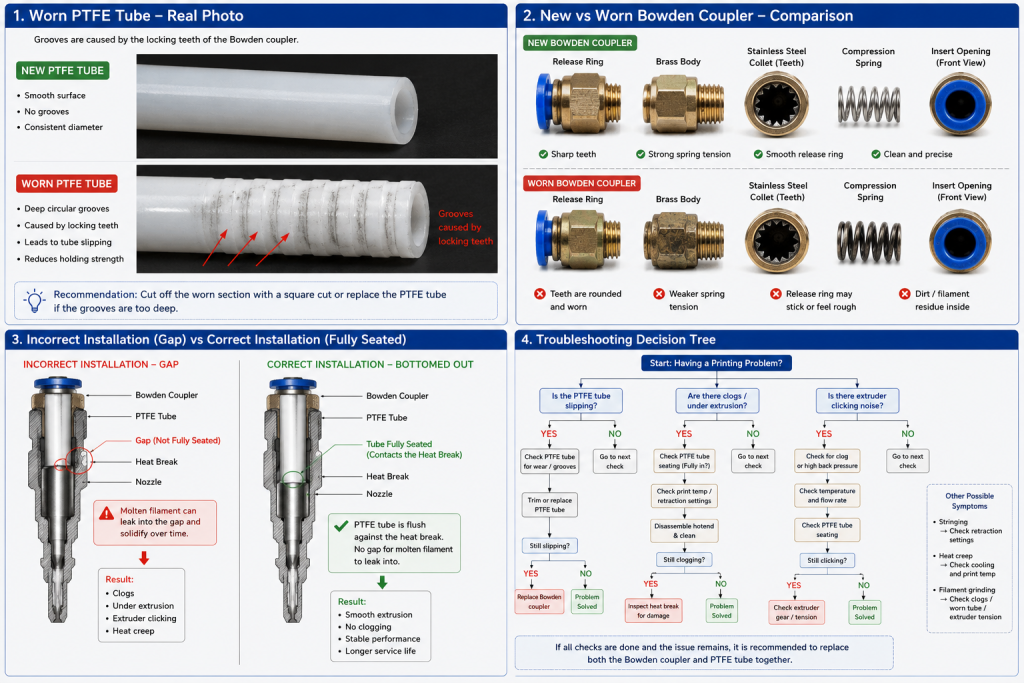
Over time, however, the repeated movement caused by extrusion and retraction cycles gradually wears both the locking teeth and the outer surface of the PTFE tube. Once the teeth become rounded or the tube develops deep grooves, the gripping force decreases and tube slippage becomes more likely.
Compression Spring – Maintaining Constant Holding Pressure
The compression spring provides the preload that keeps the collet and locking teeth engaged.
Without the spring, the locking teeth would not automatically return to their gripping position after tube installation.
Although relatively small, the spring performs several important functions:
- Maintains constant contact pressure
- Compensates for minor manufacturing tolerances
- Supports repeated insertion and removal cycles
- Keeps the locking mechanism responsive
Spring quality has a direct influence on coupler reliability.
A spring with insufficient preload may allow slight tube movement during printing, while excessive preload can increase insertion force and accelerate wear on the PTFE tube.
For this reason, reputable manufacturers carefully balance spring stiffness with tube retention performance.
Release Ring – Quick Tube Removal Without Tools
The release ring, sometimes called the release collar, provides one of the biggest advantages of push-to-connect technology.
Instead of unscrewing the fitting or cutting the tubing, users simply press the release ring toward the fitting body.
This action moves the collet forward and temporarily separates the locking teeth from the tube.
Once the gripping force is removed, the PTFE tube slides out smoothly.
Because the release mechanism does not permanently deform the locking teeth, the fitting can generally be reused multiple times, provided the internal components remain in good condition.
Many industrial manufacturers also recommend installing a locking clip beneath the release ring in applications where vibration or accidental contact could cause unintended release.
Although originally developed for pneumatic systems, this practice has also become common in the 3D printing community, particularly on Bowden extruders that experience continuous retraction cycles.
Understanding the Locking Mechanism
The locking sequence of a Bowden coupler can be divided into five simple steps.
Step 1 – Tube Insertion
The PTFE tube enters through the release ring and contacts the locking teeth.
As insertion force increases, the teeth expand outward just enough for the tube to pass.
Step 2 – Tube Seating
The tube continues moving until it reaches the internal tube stop.
Correct tube seating is critical because any gap between the PTFE tube and the hot-end throat may later allow molten filament to accumulate.
Step 3 – Spring Engagement
Once insertion is complete, the compression spring pushes the collet backward.
The locking teeth return to their normal position and grip the outer wall of the PTFE tube.
Step 4 – Self-Locking Under Load
During printing, extrusion and retraction generate repeated axial forces on the tube.
Instead of releasing the tube, these forces increase the contact pressure between the locking teeth and the PTFE surface.
This is why properly manufactured push-to-connect fittings become more secure when subjected to moderate pulling loads.
Step 5 – Controlled Release
When maintenance is required, pressing the release ring moves the collet forward, disengaging the locking teeth.
The PTFE tube can then be removed without twisting, cutting, or damaging the fitting.
Understanding this sequence makes it easier to diagnose common failures. In most cases, slipping tubes are not caused by incorrect installation alone but by gradual wear of the locking teeth, deformation of the PTFE tube, or reduced spring performance after prolonged service.
Why Do Bowden Couplers Fail?
Although Bowden couplers are designed to provide reliable tube retention, they are not permanent components. Like nozzles, PTFE tubes, and drive gears, they experience gradual wear during normal operation.
In a typical FDM printer, every print contains thousands—or even millions—of extrusion and retraction cycles. During each cycle, the PTFE tube is subjected to small axial movements, vibration, thermal expansion, and continuous loading from the extruder.
Over time, these repeated mechanical forces reduce the coupler’s holding performance.
Understanding why Bowden couplers fail is essential for diagnosing extrusion problems before they develop into serious print failures.
PTFE Tube Wear
The most common failure is not the coupler itself—it is the PTFE tube.
Although PTFE is well known for its low coefficient of friction and excellent chemical resistance, it is still a relatively soft engineering plastic compared with hardened stainless steel.
Every time the printer performs a retraction, the locking teeth apply localized pressure to the outside of the tube.
After thousands of cycles, the teeth gradually create shallow grooves around the tube surface.
Initially, these grooves have little effect.
However, as they become deeper, the locking teeth no longer grip a smooth cylindrical surface. Instead, they repeatedly engage the worn grooves, allowing microscopic tube movement during every retraction cycle.
Eventually, the tube begins to slide.
Common symptoms
- PTFE tube slowly moves upward during printing
- Inconsistent extrusion
- Increased retraction distance
- Visible wear marks around the tube
- Reduced print quality
Recommended solution
- Cut away the worn section of the PTFE tube.
- Ensure the cut is perfectly square.
- Reinsert the tube until it reaches the internal tube stop.
- Replace the tube if excessive wear is present.
Worn Locking Teeth
The stainless steel teeth are designed to grip the tube repeatedly.
However, repeated insertion, removal, vibration, and tube movement gradually round the sharp gripping edges.
Once this happens, the teeth can no longer generate sufficient radial holding force.
Instead of locking the tube firmly, they begin slipping over the worn PTFE surface.
This problem becomes especially noticeable after replacing the PTFE tube.
Many users assume the new tube will solve the issue, only to discover that the coupler itself has already reached the end of its service life.
Signs of worn locking teeth
- New PTFE tube still slips
- Tube pulls out with little resistance
- Locking feels weaker than before
- Visible polishing or wear inside the collet
Because the locking teeth are not designed to be sharpened or repaired, replacing the entire coupler is generally the recommended solution.
Improper Tube Seating
One of the most common installation mistakes is failing to fully seat the PTFE tube against the internal tube stop.
Even a gap of less than one millimeter can create serious printing problems.
When molten filament exits the PTFE tube, it enters the heat break before reaching the nozzle.
If a gap exists between these components, molten plastic expands into the empty space.
As the material cools, it forms a hardened plug.
This plug gradually increases extrusion resistance until complete blockage occurs.
Typical symptoms
- Random nozzle clogging
- Extruder clicking
- Under extrusion
- Heat creep
- Filament grinding
Because the clog develops above the nozzle, replacing the nozzle alone often fails to solve the problem.
Correct installation requires pushing the PTFE tube firmly against the internal stop before securing the coupler.
Excessive Retraction Settings
Retraction is essential for reducing stringing, but excessive retraction also increases mechanical stress on the Bowden system.
Long retraction distances force the PTFE tube to experience greater cyclic loading.
This repeated loading accelerates:
- Tube wear
- Tooth wear
- Spring fatigue
- Tube movement
Modern slicers generally recommend optimizing both retraction distance and retraction speed rather than simply increasing either value.
Lower mechanical stress often results in longer service life for both the PTFE tube and the Bowden coupler.
Spring Fatigue
Although less common, the compression spring inside the coupler can also lose preload after prolonged use.
Reduced spring force allows the collet to move more freely.
As preload decreases, the locking teeth cannot maintain consistent contact pressure on the PTFE tube.
The result is intermittent slipping that may appear only during long prints or high-speed retraction.
Because the spring cannot normally be serviced independently, replacing the coupler is the most practical solution.
Poor Manufacturing Quality
Not all Bowden couplers are manufactured to the same standard.
Low-quality fittings often exhibit:
- Poor machining accuracy
- Inconsistent spring force
- Soft locking teeth
- Rough internal surfaces
- Loose dimensional tolerances
These defects reduce holding performance long before visible wear appears.
When selecting replacement fittings, users should consider:
- Material quality
- Precision machining
- Consistent thread dimensions
- Reliable spring preload
- Stainless steel locking teeth
- Compatibility with the PTFE tube diameter
Although premium couplers typically cost slightly more, they often provide significantly longer service life and more consistent printing performance.
Common Symptoms of a Failing Bowden Coupler
Because Bowden couplers fail gradually rather than suddenly, early symptoms are often overlooked.
The following problems frequently indicate that the coupler should be inspected.
PTFE Tube Slipping
The tube slowly moves upward during printing, especially after repeated retractions.
Frequent Nozzle Clogs
A small gap forms between the PTFE tube and the hot end, allowing molten filament to accumulate.
Under Extrusion
Reduced filament flow occurs because the tube moves instead of transmitting extrusion force efficiently.
Stringing
Tube movement changes the effectiveness of retraction, increasing oozing and string formation.
Extruder Clicking
The extruder motor skips steps because extrusion resistance continues to increase.
Key Takeaways
- Most Bowden coupler failures are caused by gradual wear rather than sudden breakage.
- PTFE tube wear is often the first component to fail.
- Worn locking teeth cannot reliably grip even a new PTFE tube.
- Improper tube seating is a leading cause of nozzle clogs.
- Excessive retraction settings accelerate wear throughout the Bowden system.
- Regular inspection of both the PTFE tube and the coupler significantly improves long-term printing reliability.
Troubleshooting and Maintenance Guide
Even a high-quality Bowden coupler requires periodic inspection and maintenance. Because most failures develop gradually, identifying early warning signs can prevent print interruptions, reduce wasted filament, and extend the service life of the entire extrusion system.
The following troubleshooting process follows the same logical sequence that experienced technicians use when diagnosing Bowden extrusion problems.
Step 1 – Inspect the PTFE Tube
Always begin with the PTFE tube.
The tube experiences constant loading during extrusion and retraction, making it the first component that should be inspected.
Disconnect the tube from the Bowden coupler and examine both ends carefully.
Look for:
- Circular grooves created by the locking teeth
- Scratches or deformation
- Burn marks caused by excessive heat
- Oval or compressed tube ends
- Discoloration near the hot end
If the tube shows only light wear, remove the damaged section with a sharp tube cutter.
The cut should be perfectly square.
An angled cut may prevent the tube from fully contacting the internal tube stop, increasing the risk of filament leakage and clogging.
If the tube has become brittle, permanently deformed, or heavily worn, replace it completely rather than attempting to reuse it.
Step 2 – Check the Bowden Coupler
Once the PTFE tube has been inspected, examine the coupler itself.
Although most internal components cannot be disassembled without damage, several signs can indicate wear.
Check whether:
- The release ring moves smoothly.
- The tube locks firmly after insertion.
- The tube can be pulled out without pressing the release ring.
- The fitting feels loose inside the extruder or hot end.
- The threaded body shows damage or corrosion.
If the PTFE tube slides out with only light pulling force, the locking teeth have likely worn beyond their effective service life.
Because Bowden couplers are relatively inexpensive, replacement is generally more economical than attempting repair.
Step 3 – Verify Proper Tube Seating
Incorrect installation is responsible for many extrusion problems that are mistakenly blamed on the nozzle.
After inserting the PTFE tube, gently pull it backward without pressing the release ring.
The tube should remain firmly locked.
Next, confirm that the tube has reached the internal tube stop.
Any gap between the PTFE tube and the heat break allows molten filament to expand into the empty space.
Over time, this material hardens and forms a blockage above the nozzle.
Whenever the hot end is serviced, the PTFE tube should also be checked to ensure full contact with the internal stop.
Step 4 – Review Retraction Settings
Mechanical wear is influenced not only by hardware quality but also by printer configuration.
Retraction settings that are unnecessarily aggressive increase stress on both the PTFE tube and the Bowden coupler.
If premature wear occurs repeatedly, review:
- Retraction distance
- Retraction speed
- Printing speed
- Extrusion temperature
- Filament type
Rather than maximizing retraction distance, adjust settings gradually until stringing is minimized while maintaining stable extrusion.
Balanced settings reduce unnecessary mechanical loading and extend component life.
Preventive Maintenance Best Practices
Routine inspection requires only a few minutes but can prevent many common printing failures.
Experienced users often include the Bowden system in their regular maintenance schedule.
Recommended practices include:
Inspect the PTFE Tube Regularly
Examine both tube ends after long printing sessions or before starting large production jobs.
Replace the tube if grooves become deep or if the tube no longer fits securely.
Replace Worn Couplers Early
A Bowden coupler rarely fails without warning.
Replacing it at the first signs of reduced holding force is less expensive than recovering failed prints or replacing damaged hot-end components.
Keep Components Clean
Dust, filament debris, or small plastic particles may accumulate around the release ring.
Although the internal mechanism is largely protected, keeping the fitting clean helps maintain smooth operation.
Avoid using excessive lubricants, as they can attract dust and reduce gripping performance.
Use High-Quality Components
Reliable performance depends on the quality of every component in the filament path.
When selecting replacement parts, consider:
- Precision-machined brass body
- Hardened stainless steel locking teeth
- Consistent spring preload
- Accurate thread dimensions
- Compatibility with the PTFE tube outside diameter
Choosing high-quality fittings often reduces maintenance frequency and improves print consistency over the long term.
Replace Related Wear Components Together
The PTFE tube and Bowden coupler wear together.
Replacing only one component while leaving the other heavily worn often provides only temporary improvement.
For printers that have accumulated many printing hours, replacing both components at the same time is usually the most reliable approach.
Maintenance Schedule
The exact maintenance interval depends on printing volume, filament type, and retraction frequency.
The following inspection schedule serves as a general guideline.
| Component | Inspection | Replacement (Typical) |
|---|---|---|
| PTFE Tube | Every few weeks of regular use | When grooves, deformation, or heat damage appear |
| Bowden Coupler | Check tube retention during maintenance | When holding force decreases or locking becomes unreliable |
| Hot End | Inspect during nozzle replacement | As required |
| Nozzle | Inspect regularly for wear or blockage | Depends on filament type and usage |
Rather than replacing components on a fixed calendar schedule, monitor their condition and replace them when measurable wear begins to affect printing performance.
Key Takeaways
- Most Bowden system failures can be diagnosed through a systematic inspection process.
- Always inspect the PTFE tube before replacing more expensive components.
- Correct tube seating is essential for preventing hot-end clogs.
- Balanced retraction settings reduce long-term mechanical wear.
- Preventive maintenance is significantly more cost-effective than recovering failed prints.
- Replacing the PTFE tube and Bowden coupler together often restores the most reliable extrusion performance.
How to Choose the Right Bowden Coupler
Choosing a Bowden coupler may appear straightforward because most fittings look nearly identical from the outside. However, significant differences exist in materials, manufacturing tolerances, internal design, and service life.
A high-quality Bowden coupler should not only hold the PTFE tube securely but also maintain consistent performance after thousands of extrusion and retraction cycles. Poorly manufactured fittings often lose their holding force prematurely, leading to tube movement, extrusion inconsistencies, and unnecessary maintenance.
When selecting a replacement or specifying components for a new printer, consider the following engineering factors.
Select the Correct Thread Size
One of the first considerations is thread compatibility.
Most desktop FDM printers use one of two common thread specifications:
| Model | Typical Application |
|---|---|
| PC4-M6 | Extruder side |
| PC4-M10 | Hot-end side |
In these model names:
- PC generally refers to a pneumatic or push coupling.
- 4 indicates compatibility with 4 mm outside diameter (OD) tubing.
- M represents a metric thread.
- 6 or 10 refers to the thread diameter.
Although PC4-M6 and PC4-M10 appear similar, they are not interchangeable. Always verify the thread specification recommended by the printer manufacturer before purchasing a replacement.
Verify PTFE Tube Compatibility
A Bowden coupler is designed to grip the outside diameter of the tube rather than the inside diameter.
Most FDM printers use PTFE tubing with:
- 4 mm outside diameter (OD)
- 2 mm inside diameter (ID)
Some high-performance tubing may have tighter dimensional tolerances than standard PTFE tubing.
A coupler manufactured with poor dimensional control may either:
- Fail to grip the tube securely, or
- Apply excessive pressure that accelerates tube wear.
For reliable operation, both the tube and the fitting should conform to consistent dimensional tolerances.
Evaluate Material Quality
Material selection directly influences service life.
A quality Bowden coupler typically includes:
Brass Body
The housing should be precisely machined from brass to provide:
- Good corrosion resistance
- High dimensional stability
- Excellent thread durability
Nickel-plated brass further improves corrosion resistance in humid environments.
Stainless Steel Locking Teeth
The locking teeth should be manufactured from hardened stainless steel.
Properly manufactured teeth:
- Maintain sharp gripping edges
- Resist wear
- Provide consistent tube retention
- Perform reliably over repeated insertion cycles
Soft or poorly heat-treated teeth may polish quickly, reducing holding force.
Compression Spring
The internal spring should provide stable preload throughout its service life.
Uneven spring force can lead to inconsistent locking performance, especially during long prints with frequent retractions.
Consider Manufacturing Precision
Precision machining often distinguishes premium fittings from low-cost alternatives.
Important quality indicators include:
- Smooth release ring movement
- Uniform thread dimensions
- Accurate concentricity
- Consistent insertion depth
- Reliable tube retention
High-quality manufacturers also perform dimensional inspections during production to ensure repeatable performance across large production batches.
Bowden Coupler vs. Compression Fitting
Both Bowden couplers and compression fittings are used to secure tubing, but they operate using different mechanical principles.
| Feature | Bowden Coupler | Compression Fitting |
|---|---|---|
| Installation | Push-to-connect | Tightened with wrench |
| Tube Removal | Tool-free | Requires loosening |
| Reusability | High | Moderate |
| Installation Speed | Very fast | Slower |
| Maintenance | Easy | More involved |
| Typical Applications | FDM printers, pneumatic systems | Industrial fluid systems |
A Bowden coupler is optimized for applications where tubing may require periodic replacement or maintenance.
Compression fittings are better suited to permanent installations where maximum resistance to vibration or pressure is required.
Neither design is universally better. The appropriate choice depends on the application, operating conditions, and maintenance requirements.
Quality Inspection Checklist
Before installing a new Bowden coupler, inspect the following items.
✓ Threads are clean and free from burrs.
✓ Release ring moves smoothly without sticking.
✓ Locking teeth appear sharp and evenly spaced.
✓ PTFE tube inserts smoothly to the internal tube stop.
✓ Tube cannot be removed without pressing the release ring.
✓ Thread size matches the printer specification.
Performing this simple inspection before installation can help identify manufacturing defects before they affect print quality.
Applications Beyond 3D Printing
Although Bowden couplers are widely recognized within the 3D printing community, the push-to-connect mechanism originated in industrial pneumatic systems.
Today, similar fittings are used in:
- Pneumatic automation equipment
- Air distribution systems
- Reverse osmosis (RO) water filtration systems
- Laboratory fluid handling equipment
- Beverage dispensing systems
- Medical and analytical instruments
The widespread adoption of push-fit technology across multiple industries demonstrates the reliability and versatility of the self-locking collet mechanism when properly designed and manufactured.
Key Takeaways
- Always verify thread compatibility before purchasing a replacement.
- PTFE tube dimensions are just as important as coupler dimensions.
- Material quality has a direct impact on service life.
- Precision manufacturing improves tube retention and reduces wear.
- Bowden couplers are ideal for applications requiring quick maintenance, while compression fittings are better suited to permanent mechanical connections.
- A simple pre-installation inspection helps prevent many common fitting-related failures.
Frequently Asked Questions
1. How long does a Bowden coupler typically last?
There is no fixed service life because durability depends on printing hours, retraction frequency, filament type, and the quality of the coupler itself.
For hobby printers used occasionally, a Bowden coupler may last many months. In production environments where printers operate daily, regular inspection is recommended because repeated retraction cycles gradually wear both the locking teeth and the PTFE tube.
Rather than replacing the coupler on a schedule, inspect it whenever extrusion quality begins to decline.
2. Why does my PTFE tube keep slipping out?
The most common causes include:
- Worn locking teeth
- Grooves on the PTFE tube
- Incorrect tube diameter
- Improper tube insertion
- Weak spring preload
Replacing only the PTFE tube may not solve the problem if the coupler itself has already worn.
3. Can a bad Bowden coupler cause nozzle clogs?
Yes.
If the PTFE tube moves away from the heat break, a small gap forms between the tube and the nozzle assembly.
Molten filament expands into this space and solidifies, eventually creating a blockage above the nozzle.
Many recurring “nozzle clogs” are actually caused by poor PTFE tube retention rather than by the nozzle itself.
4. Can I reuse a Bowden coupler?
In many cases, yes.
If the release ring moves freely, the locking teeth remain sharp, and the spring still provides sufficient holding force, the coupler can normally be reused.
However, if the tube can be pulled out without pressing the release ring, replacement is recommended.
5. Should I replace the PTFE tube and Bowden coupler together?
For printers that have accumulated significant printing hours, replacing both components together often produces the most reliable results.
A new tube installed in a worn coupler—or a worn tube installed in a new coupler—may still lead to reduced holding performance.
6. What’s the difference between PC4-M6 and PC4-M10?
Both fittings are designed for 4 mm outside diameter PTFE tubing.
The difference is the threaded connection.
- PC4-M6 uses an M6 thread.
- PC4-M10 uses an M10 thread.
Always confirm your printer’s specifications before ordering replacement parts.
7. Does the quality of PTFE tubing affect coupler performance?
Absolutely.
PTFE tubing manufactured with poor dimensional consistency may not fit securely inside the coupler.
High-quality tubing with consistent outside diameter tolerances generally provides better holding performance and more reliable extrusion.
8. Why is the release ring difficult to press?
Dust, filament debris, or mechanical wear may increase friction around the release mechanism.
Do not force the release ring with excessive pressure.
Inspect the fitting for contamination or damage and replace it if normal movement cannot be restored.
9. Should I lubricate a Bowden coupler?
Generally, no.
Lubricants may attract dust and plastic particles, reducing the effectiveness of the locking mechanism.
Keeping the fitting clean is usually more beneficial than applying grease or oil.
10. How can I extend the service life of a Bowden coupler?
The following practices significantly improve service life:
- Use high-quality PTFE tubing.
- Avoid excessive retraction settings.
- Ensure the PTFE tube is fully seated.
- Inspect both tube ends regularly.
- Replace worn components before complete failure occurs.
Conclusion
Although small in size, the Bowden coupler plays a critical role in the performance of any Bowden-style extrusion system.
Its push-to-connect design combines a brass body, spring-loaded collet, stainless steel locking teeth, and release ring into a compact mechanism capable of securely retaining PTFE tubing while allowing quick maintenance.
Like any mechanical component, however, it is subject to wear. Repeated extrusion and retraction cycles gradually affect both the locking teeth and the PTFE tube, eventually reducing holding force and increasing the likelihood of tube movement, nozzle clogs, and inconsistent extrusion.
By understanding how a Bowden coupler works, recognizing the early signs of wear, and following a routine maintenance schedule, users can significantly improve printing reliability and reduce unexpected downtime.
When selecting replacement components, prioritize precision manufacturing, high-quality materials, and compatibility with your PTFE tubing. Investing in reliable fittings not only extends component life but also contributes to more consistent print quality and lower long-term maintenance costs.
Whether you are maintaining a desktop 3D printer, designing a custom extrusion system, or sourcing components for industrial applications, a properly engineered Bowden coupler remains an essential part of a dependable filament delivery system.
Source
- Capricorn Tubing – Installation Guide
Covers correct PTFE tube seating, square cuts, and preventing gaps that lead to clogs.
https://www.captubes.com/howto.html - John Guest – Push-Fit Installation Guidance
Explains correct insertion depth and release procedures for push-fit fittings.
https://www.johnguest.com/ - Prusa Knowledge Base
Documents PTFE tube wear, hot-end assembly, and clog prevention in Bowden-based systems.
https://help.prusa3d.com/ - Community Experience (Reddit / 3D Printing Stack Exchange)
Used to validate real-world failure patterns such as tube slipping, worn couplers, and retraction-related wear. These sources are treated as user experience rather than primary engineering references. - Capricorn Tubing – Installation & Maintenance Guide
Guidance on square-cut PTFE tubes, proper tube seating, and preventing gaps in the hot end. - Prusa Knowledge Base
Best practices for PTFE tube inspection, hot-end maintenance, and troubleshooting extrusion issues. - John Guest – Push-Fit Installation Recommendations
General maintenance principles for push-fit fittings and correct tube insertion/removal procedures. - Community Technical Experience (Reddit & 3D Printing Stack Exchange)
Used to validate common maintenance practices and real-world troubleshooting scenarios, complementing manufacturer guidance. - John Guest – Standard Speedfit: How to Make a Connection
Official guidance on push-fit installation, collet locking systems, stainless-steel grippers, tube stops, and correct tube insertion.
John Guest – How To Make a Connection – Standard Speedfit - John Guest – Official Product Information
Overview of push-to-connect fitting technology, applications, and engineering design.
John Guest Official Website - Parker – Fittings, Materials, and Tubing Guide (PDF)
Engineering guidance on fitting materials, tubing compatibility, and material selection for fluid systems.
Parker Fittings, Materials, and Tubing Guide (PDF) - Reddit Discussion – PC4-M6 vs. PC4-M10 Naming
Community explanation of the PC4-M6 / PC4-M10 naming convention and common usage in 3D printers. Used only as supplementary real-world context, not as an engineering authority.