
How Does a Bowden Coupler Work? A Complete Guide to Push-to-Connect PTFE Fittings
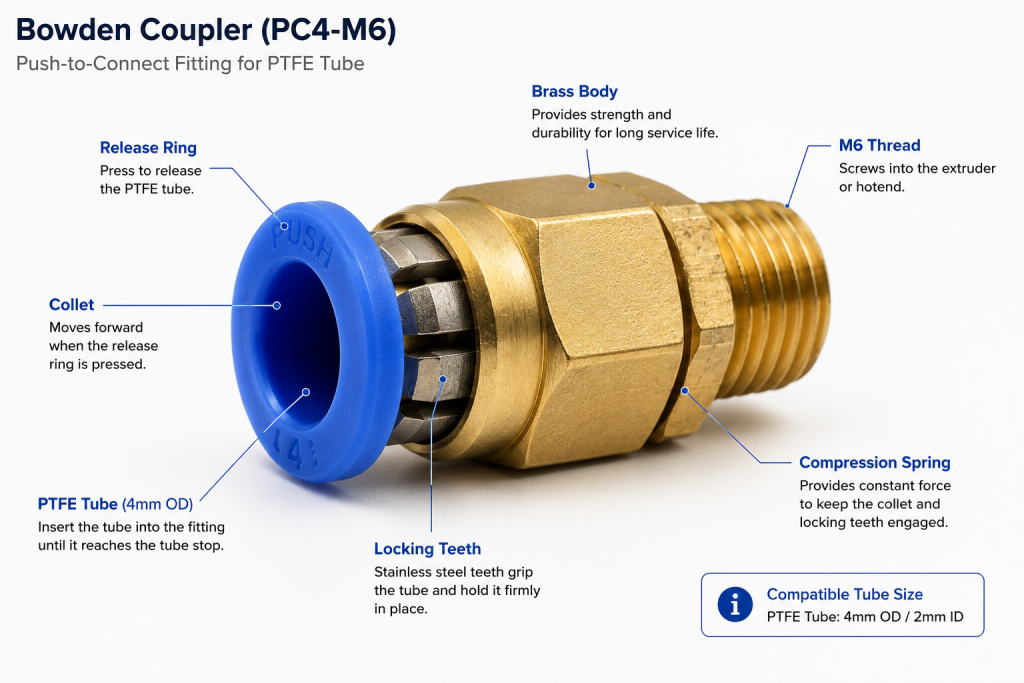
Introduction
A Bowden coupler is one of the smallest components in a Bowden extrusion system, yet it has a significant impact on printing reliability. Although it typically costs only a few dollars, a worn or improperly installed coupler can lead to a wide range of printing problems, including PTFE tube movement, inconsistent extrusion, filament jams, under-extrusion, and poor surface quality.
Many users replace nozzles, extruders, or even hot ends when these symptoms appear, only to discover that the actual cause is a worn push-to-connect fitting. Because the Bowden coupler sits between the PTFE tube and the extruder or hot end, even slight movement of the tube can interrupt the filament path and reduce extrusion consistency.
Originally developed for pneumatic systems, push-to-connect fittings were designed to hold flexible tubing securely while allowing quick installation and removal. In modern FDM 3D printers, the same mechanical principle is used to lock PTFE tubing in place while maintaining a smooth filament path between the extruder and the hot end. Over thousands of extrusion and retraction cycles, however, the locking mechanism gradually wears, making the coupler a consumable component rather than a permanent one.
Understanding how a Bowden coupler works is therefore essential not only for troubleshooting print failures but also for selecting the right fitting, installing it correctly, and maintaining long-term printing reliability.
In this guide, you’ll learn:
What a Bowden coupler is and why it is important.
How the internal push-to-connect mechanism works.
Why Bowden couplers eventually fail.
Common symptoms of a worn coupler.
Practical maintenance and replacement recommendations.
What Is ASTM International? A Practical Guide for Industrial Buyers and Manufacturers

ASTM standards are widely used in material selection, product testing, quality inspection, and industrial purchasing. However, “ASTM compliant” is often used too vaguely.
This article explains what ASTM International is, what ASTM standards mean, and how they apply to plastics and fluoropolymer tubing such as PTFE, FEP, PFA, and ETFE.