
High-Purity Fluid Qualification Guide
SEMI F57 Tubing: A Practical Guide to High-Purity PFA Qualification
Understand what SEMI F57 covers, how extraction testing is interpreted, and what evidence to request before approving tubing for semiconductor UPW and chemical systems.

In semiconductor fluid handling, tubing cannot be selected only by chemical resistance, temperature capability, or pressure rating. A tube may transport an aggressive chemical without visible damage and still release trace metals, ions, organic compounds, or particles into the process fluid.
This is why engineers and procurement teams frequently specify SEMI F57 tubing for ultrapure water and high-purity chemical distribution systems.
However, SEMI F57 is often misunderstood. It is not a polymer name, a tubing size standard, or a general pressure specification. It is a performance and validation framework for high-purity polymer materials and fluid-handling components.
This guide explains what SEMI F57 tubing means, how the current standard applies, how testing is performed, and what evidence buyers should request before approving a tubing supplier.
1. What Is SEMI F57 Tubing?
“SEMI F57 tubing” generally refers to polymer tubing that has been evaluated against the requirements of SEMI F57, formally titled:
Specification for High Purity Polymer Materials and Components Used in Ultrapure Water and Liquid Chemical Distribution Systems.
SEMI F57 establishes minimum performance requirements for ultra-high-purity polymer materials and components used to convey ultrapure water. It also provides recommendations for polymer components used in high-purity liquid chemical distribution systems.

The standard covers more than tubing. It may apply to:
- Tubing and pipe
- Fittings
- Valves
- Manifolds
- Pumps and fluid-handling components
- Raw polymer materials
- Wetted component surfaces
Therefore, SEMI F57 tubing is not a separate plastic material. It is tubing whose material, finished form, or defined product configuration has been tested or qualified against applicable SEMI F57 requirements.
The most common material associated with this keyword is high-purity PFA tubing, although the standard is written for polymer materials and components more broadly.
2. Current SEMI F57-0622 Revision
The current version listed by SEMI is:
SEMI F57-0622
Older versions shown by SEMI include:
- SEMI F57-0120
- SEMI F57-0314
- SEMI F57-0312
- SEMI F57-0301
- SEMI F57-1000
These older editions are marked as superseded.
This matters because many supplier pages, specification sheets, and historical test reports still refer to earlier editions. A product page that only says “SEMI F57 compliant” without stating the revision does not provide enough information for a current qualification decision.
A procurement specification should identify:
- Applicable SEMI F57 revision
- Sample-preparation standard
- Test date
- Tested product and size
- Acceptance criteria used
- Laboratory name
- Test-report number
For example:
Finished PFA tubing tested against SEMI F57-0622, with samples prepared in accordance with SEMI F40-0621.
A report may use a testing procedure derived from an older revision while comparing the results with newer limits. When that occurs, the supplier should explain the relationship clearly rather than leaving the buyer to interpret conflicting revision references.
3. Where Does SEMI F57 Apply?
SEMI F57 is primarily associated with systems that must preserve extremely low contamination levels.
Typical applications include:
- Semiconductor ultrapure-water distribution
- Bulk chemical supply systems
- Facility chemical-distribution systems
- Wet-process equipment
- Wafer-cleaning equipment
- Wet benches
- Chemical dispense modules
- Point-of-use fluid lines
- Photovoltaic wet-processing equipment
- Other high-purity liquid systems
The official standard identifies UPW distribution and liquid chemical distribution at the bulk-supply, facility-distribution, and process-equipment levels.
The standard also lists fluids such as:
- Ultrapure water
- Acids
- Bases
- Oxidizers
- Aqueous salt solutions
- Solvents
However, the main F57 extraction framework is based on testing with UPW under elevated-temperature conditions. SEMI explicitly notes that it cannot define test parameters for every possible chemical stream.
Consequently, F57 qualification does not automatically prove compatibility with every acid, solvent, oxidizer, concentration, temperature, or operating condition. Application-specific chemical testing may still be required.
4. Standard PFA vs. High-Purity PFA
Standard PFA and high-purity PFA belong to the same general perfluoroalkoxy polymer family, but they should not be treated as interchangeable in contamination-sensitive systems.
PFA is widely used because it combines:

- Broad chemical resistance
- Melt processability
- High-temperature capability
- Low surface energy
- The ability to be extruded into long continuous tubing
- Relatively smooth internal surfaces
High-purity PFA is normally produced and handled with tighter controls over raw-material contamination, metallic extractables, ionic contamination, processing equipment, packaging, and traceability.
The phrase high-purity PFA is not, by itself, proof of SEMI F57 compliance. It is a material or product-grade description. Evidence is still required to establish how the resin or finished tubing performs.
A buyer should therefore ask:
- What resin grade is used?
- Is it virgin resin?
- Does the resin supplier provide lot certification?
- Is the extrusion line dedicated or suitably controlled?
- Is the finished tubing manufactured in a clean environment?
- Was the finished tubing tested, or only the raw resin?
- Are extractables and particle results available?
AGC identifies PFA and PTFE as important materials for semiconductor chemical containers, pipes, joints, valves, pumps, and other wetted components because these parts must resist aggressive chemicals without degrading fluid purity. Zeus separately offers high-purity PFA tubing for semiconductor cleanroom and critical-fluid applications.
5. Resin Compliance vs. Finished-Tubing Compliance
One of the most important qualification questions is:
Was the raw resin tested, or was the finished tubing tested?
A resin pellet can have a low contamination profile before extrusion. During tubing production, however, the material may contact:
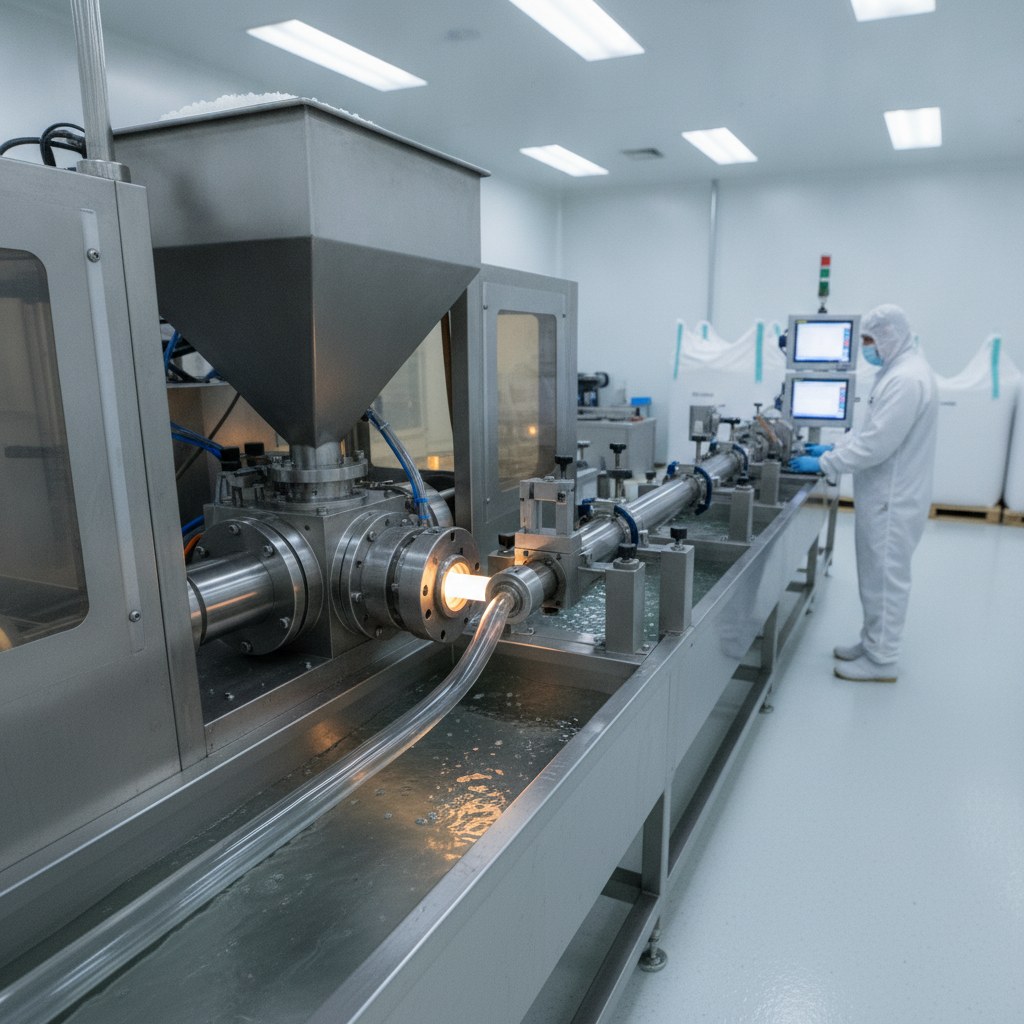
- Material-handling equipment
- Hoppers and dryers
- Extruder screws and barrels
- Dies and tooling
- Cooling water or air
- Measuring equipment
- Operators
- Cutting equipment
- Packaging materials
Each production stage can potentially introduce contamination or alter the final surface condition.
For that reason, a resin certificate alone does not prove that every finished tube made from that resin meets the same contamination limits.
The strongest evidence hierarchy is generally:
- Supplier describes the material as high purity.
- Raw-resin data are available.
- Representative finished tubing has been internally tested.
- Representative finished tubing has been tested by an independent laboratory.
- Product-size and lot-specific documentation are available.
- Production and resin lots can be traced to the relevant qualification records.
Saint-Gobain’s published example identifies the tested object as Furon HP PFA 400 1/2-inch finished tubing, rather than making only a generic resin claim. This makes the evidence more useful, although it still applies directly to the defined sample rather than automatically proving every size and production lot.
Sitemap-Verified Product Paths
Related PFA Tubing for Semiconductor Fluid Systems
Use these product and application pages to move from SEMI F57 qualification requirements to a tubing configuration for review.

High-Purity PFA Tubing
Explore clean PFA tubing options for contamination-sensitive chemical and ultrapure fluid paths.

Wafer-Process PFA Tubing
Review PFA tubing intended for wet benches, wafer cleaning tools and compact process-fluid routing.

Semiconductor PFA Tubing
Compare tubing formats for UPW, chemical cabinets, sampling lines and OEM semiconductor tools.
Chemical-Delivery PFA Tubing
Find chemically resistant PFA lines for controlled transfer, dispense modules and facility distribution.
6. The 85°C / 7-Day UPW Extraction Test
A central part of SEMI F57 evaluation is the extraction test.
CT Associates describes the process as exposing polymer materials or components to ultrapure water at:

- 85°C
- Seven days
- Prepared in accordance with SEMI F40
Tubing, pipe, valves, and other fluid-handling components can be evaluated using this approach.
The objective is to determine what contaminants migrate from the material or component into the UPW under defined conditions. The resulting extract is then analyzed for relevant contaminants such as:
- Metals
- Anions
- Total organic carbon
The elevated temperature and extended extraction period accelerate the interaction between the polymer surface and the water. The test therefore provides a controlled comparison method rather than recreating every possible operating condition.
Important test-report fields include:
- Sample surface area
- Sample geometry
- Precleaning procedure
- Extraction temperature
- Extraction duration
- UPW quality
- Blank-control results
- Detection limits
- Analytical methods
- Result units
- Applicable acceptance limits
A result without its test conditions cannot be meaningfully compared with another supplier’s result.
7. Trace-Metal Limits and Test Results
Trace-metal contribution is one of the most important SEMI F57 evaluation areas. Metals released from tubing or fluid-handling components can contaminate high-purity fluids and interfere with sensitive semiconductor processes.
A useful report should show three separate values:
- Method detection limit
- Measured result
- Applicable specification limit
Saint-Gobain’s published test report for Furon HP PFA 400 1/2-inch tubing provides an example.
Selected results reported in micrograms per square meter include:
| Metal | Reported result | F57-0622 specification |
|---|---|---|
| Boron | 15 µg/m² | 30 µg/m² |
| Calcium | 1.5 µg/m² | 10 µg/m² |
| Chromium | 0.02 µg/m² | 1 µg/m² |
| Molybdenum | 0.3 µg/m² | No specification shown |
| Nickel | 0.54 µg/m² | 1 µg/m² |
| Aluminum | Below detection limit | 5 µg/m² |
| Iron | Below detection limit | 5 µg/m² |
| Sodium | Below detection limit | 10 µg/m² |
| Copper | Below detection limit | 10 µg/m² |
The report concludes that the tested sample passed the applicable trace-metal requirements.
These results should be interpreted carefully:
- They apply to the tested product and sample.
- “Below detection limit” does not mean absolute zero.
- A result cannot be compared correctly without checking the unit and exposed surface area.
- A representative test does not necessarily equal routine batch testing.
- Elements marked “NS” were not assigned a specification limit in that report table.
Third-party data should be cited as an industry example, not presented as performance data for another supplier’s tubing.
8. Anion and TOC Test Results
Metal contamination is not the only concern. High-purity polymer components may also contribute:
- Fluoride
- Chloride
- Nitrite
- Bromide
- Nitrate
- Phosphate
- Sulfate
- Ammonium
- Organic carbon
Total organic carbon, or TOC, is used as an overall indication of organic substances released into the extraction water.
In the same Furon HP PFA 400 example, the report shows:
| Analyte | Reported result | F57-0622 specification |
|---|---|---|
| TOC | 740 µg/m² | 40,000 µg/m² |
| Fluoride | 2,000 µg/m² | 20,000 µg/m² |
| Chloride | Below 5 µg/m² detection limit | 100 µg/m² |
| Nitrite | Below 5 µg/m² detection limit | 100 µg/m² |
| Bromide | Below 10 µg/m² detection limit | 100 µg/m² |
| Nitrate | Below 10 µg/m² detection limit | 100 µg/m² |
| Phosphate | Below 10 µg/m² detection limit | 100 µg/m² |
| Sulfate | Below 10 µg/m² detection limit | 100 µg/m² |
| Ammonium | Below 10 µg/m² detection limit | 100 µg/m² |
The example demonstrates how a useful supplier report should be structured. It does not establish a universal performance value for all high-purity PFA tubing.
When comparing reports, buyers should verify that:
- The same extraction medium was used.
- The same temperature and duration were used.
- Results use comparable surface-area normalization.
- Blank values were controlled.
- Detection limits are low enough to evaluate the specification.
- The report relates to finished tubing rather than only resin pellets.
9. SEMI F57 vs. F104 vs. C90
SEMI F57 is only one part of the high-purity fluid-component qualification framework.
SEMI F57
SEMI F57 addresses high-purity polymer material and component performance, including:
- Metallic contribution
- Ionic contribution
- TOC contribution
- Surface roughness
- Mechanical and physical properties
- Chemical resistance
- Reliability
- Traceability
- Packaging
- Certification
Its main extraction framework is associated with elevated-temperature UPW testing.
SEMI F104
SEMI F104 evaluates the particle contribution of components used in UPW and liquid chemical distribution systems.
SEMI reported that F104 was extensively rewritten to address particle contributions from different component sizes and to provide updated testing procedures and allowable particle values. Particle-contribution requirements that had previously been associated with system rinse-up under F57 were moved into F104.
SEMI C90
The current version shown by SEMI is SEMI C90-0725.
C90 addresses extractable metal impurities from PFA and other fluorinated materials and from high-purity liquid-distribution components. Its scope includes exposure to nitric-acid extractants, background controls, preparation procedures, and extractable-metal limits.
A simplified comparison is:
| Standard | Primary qualification question |
|---|---|
| SEMI F57 | What metals, ions and organic contaminants are contributed under the defined UPW extraction conditions? |
| SEMI F104 | How many particles does the component contribute under the defined test procedure? |
| SEMI C90 | What metallic impurities are extracted from PFA or other fluorinated materials and components under the defined chemical test? |
Passing one standard does not automatically establish compliance with the others.
10. Surface Roughness and Particle Control
A smooth internal surface is valuable in high-purity tubing because it can reduce locations where particles, residues, or process chemicals may be retained.
SEMI F57 includes surface-roughness requirements as part of polymer component performance. However, a smooth-looking or translucent tube should not automatically be assumed to meet a defined roughness requirement.
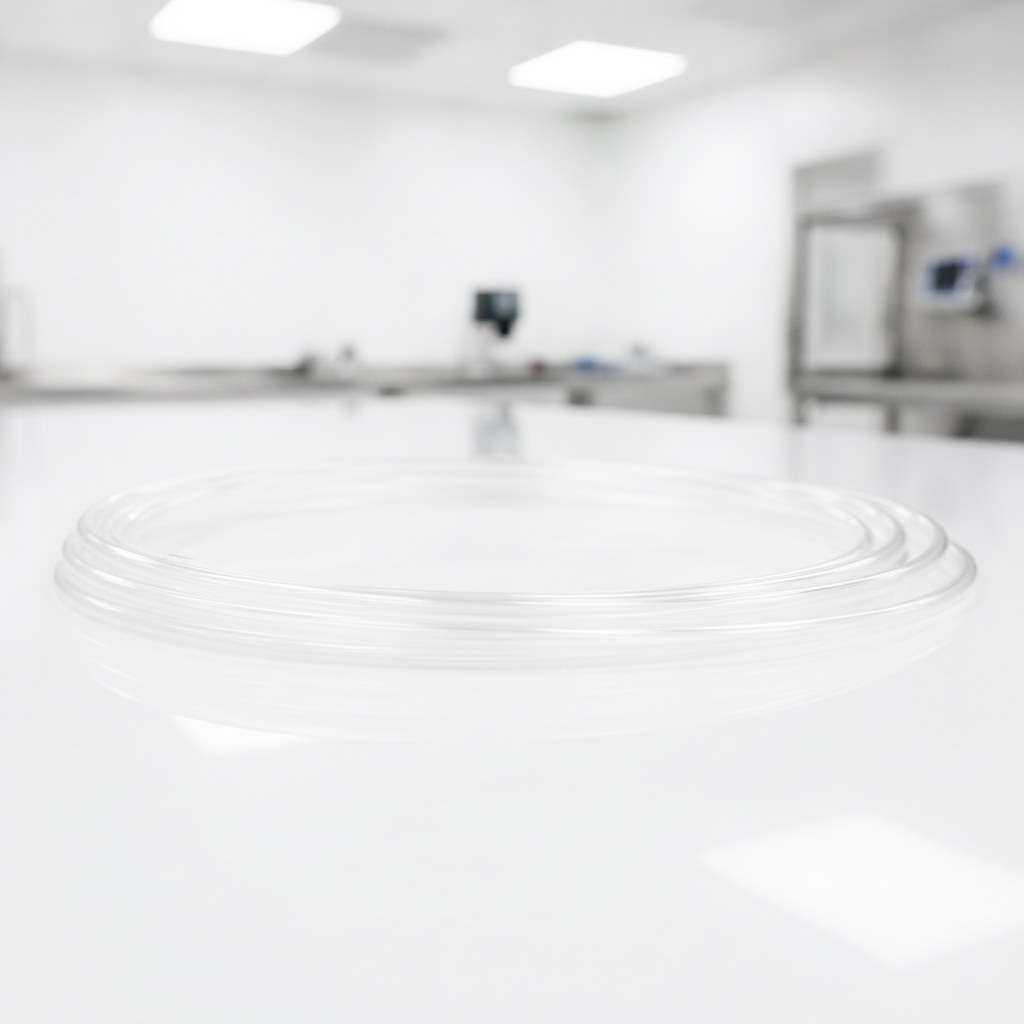
The supplier should explain:
- Whether roughness is measured on the finished internal surface
- The instrument and measurement method
- The reported parameter, such as Ra
- The sampling location
- The number of samples
- Whether the value is typical or guaranteed
Surface roughness and particle contribution are related but different concepts.
A smooth tube may still contribute particles through:
- Cutting debris
- Poor handling
- Contaminated packaging
- Installation damage
- Fitting assembly
- Mechanical abrasion
- Inadequate flushing
For particle qualification, SEMI F104 should be considered separately. CT Associates describes F57 and F104 as complementary standards for the material and performance requirements typically associated with semiconductor UPW applications.
11. Cleanroom Extrusion and Cleaning
Even when a high-purity resin is used, the extrusion environment can affect the cleanliness and dimensional consistency of the finished tubing.
Controlled manufacturing may include:

- Monitored raw-material handling
- Controlled extrusion conditions
- Clean or climate-controlled production areas
- Dedicated or validated contact surfaces
- In-process OD, ID and wall monitoring
- Controlled cutting and coiling
- Cleaning or flushing procedures
- Protected transfer to packaging
- Documentation of nonconforming material
Pexco states that its Altaflo 480 tubing is produced using precision cleanroom extrusion with in-process monitoring. It also associates tight dimensional control and smooth internal surfaces with reproducible flow and fitting reliability. These are supplier-specific claims and should be supported by the relevant product documentation when used for qualification.
A buyer should not accept “cleanroom manufactured” as a complete statement. The supplier should identify:
- Cleanroom classification or controlled-environment description
- Which stages occur inside the controlled area
- Whether extrusion, cutting and packaging occur in the same environment
- Cleaning method
- Water quality, where water is used
- Drying method
- Environmental monitoring
- Handling and gowning controls
Cleanroom production supports contamination control, but it does not replace finished-product testing.
12. End Capping and Double-Bag Packaging
The inside surface of high-purity tubing must remain protected after production.
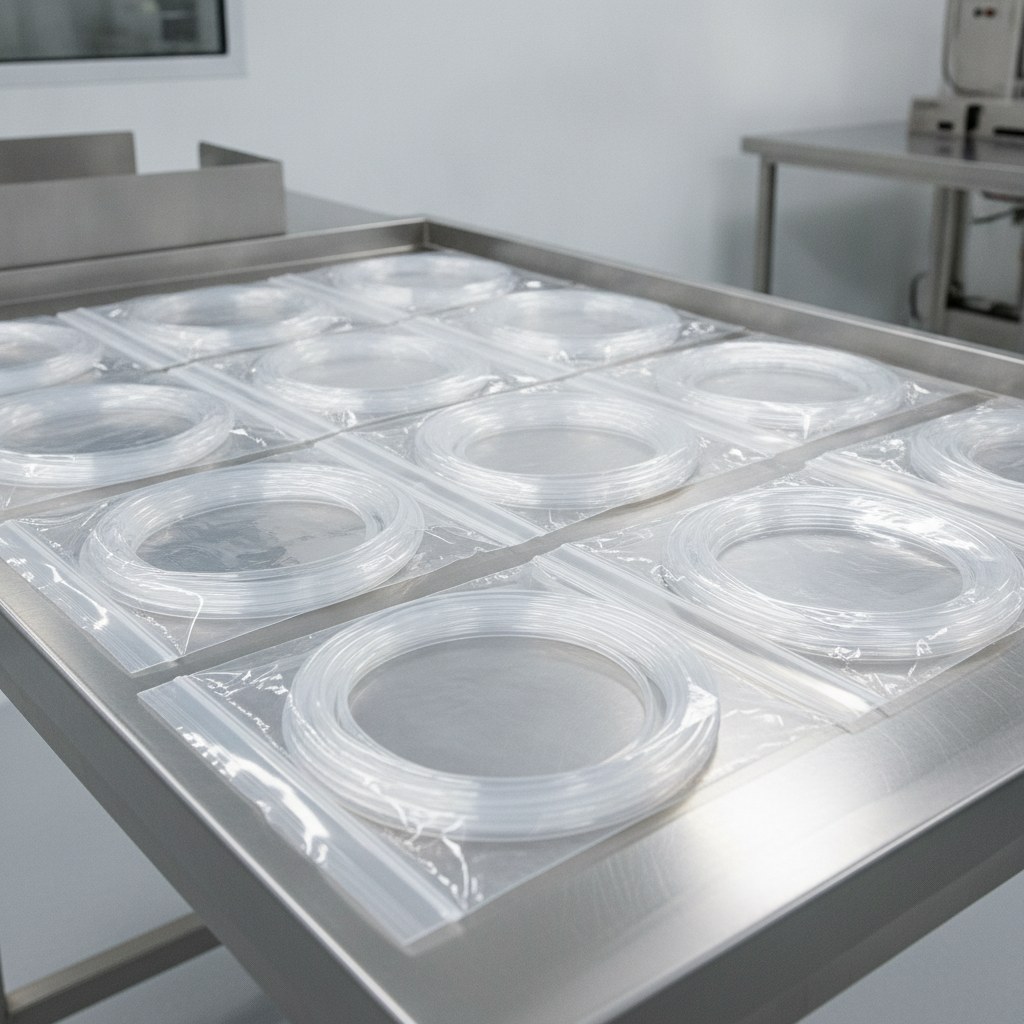
A tube that passes extraction testing can still be contaminated during:
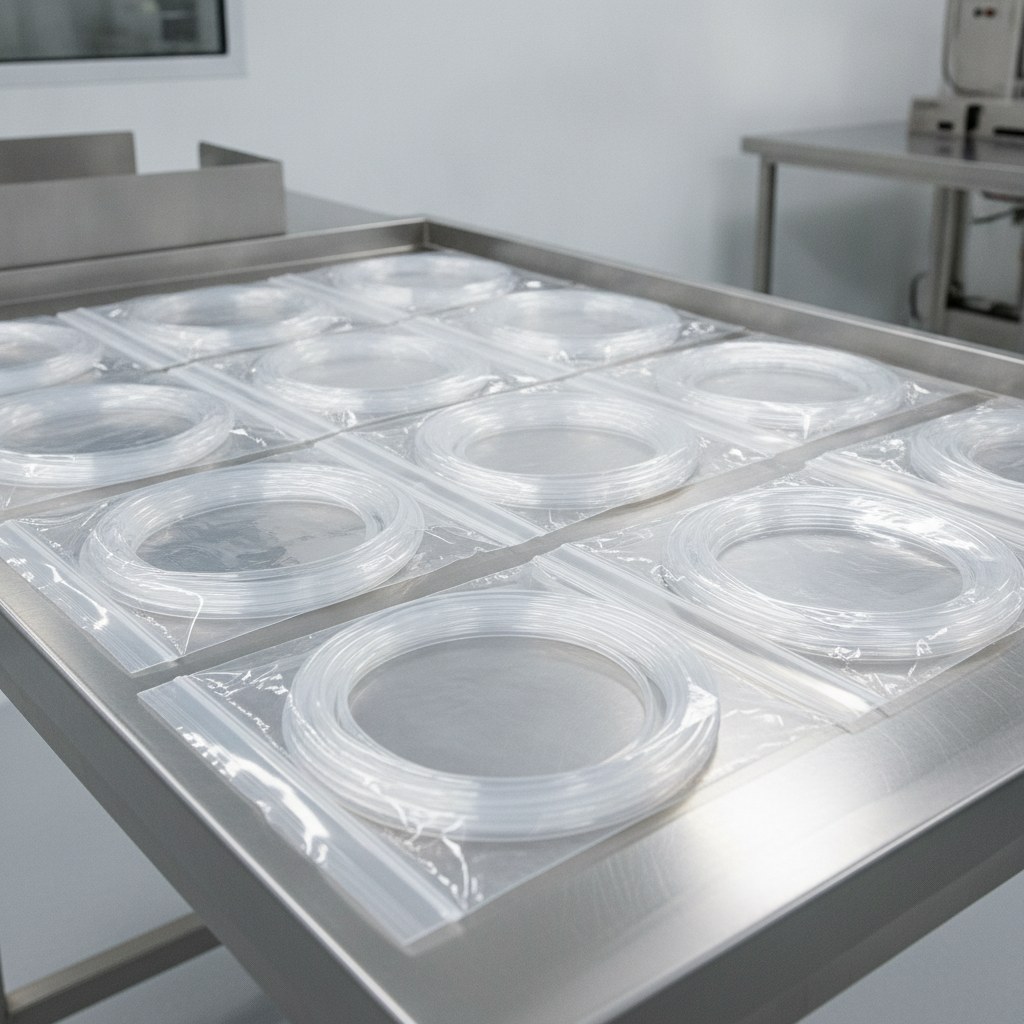
- Cutting
- Coiling
- Storage
- Warehouse handling
- Transportation
- Package opening
- Installation
Common protection options include:
- End caps or sealed ends
- Inner clean bag
- Outer transport bag
- Double-bag packaging
- Controlled coil or reel materials
- Product labels outside the clean inner package
- Defined package-opening instructions
Zeus lists double poly-bagging, secured end caps, pre-cut lengths, coils, and laser marking as packaging and identification options for PFA tubing. Saint-Gobain’s test report also states that its test sample was double-bagged for cleanliness assurance and transportation.
Furon’s 400 Series data sheet describes capped tube ends and optional Clean-Pak packaging.
Packaging requirements should specify:
- Single or double bag
- Bag material
- End-cap material
- Reel or coil material
- Packaging environment
- Maximum length per package
- Label content
- Lot identification
- Opening sequence
“Clean packaged” is not precise enough for a controlled procurement specification.
13. Lot Traceability and Change Control
Traceability enables a tube to be connected back to its raw material, production history, inspections, and test records.
SEMI F57 lists traceability, packaging, and certification among its compliance areas. A practical tubing traceability system may include:
- Resin manufacturer
- Resin grade
- Resin lot
- Extrusion lot
- Extrusion date
- Production line
- Operator or shift
- Dimensional inspection record
- Packaging date
- Product part number
- Reel or coil number
- Relevant test-report references
Furon describes laser marking for size, material identification, and lot traceability. Pexco states that its tubing can include lot identification and retrievable batch documentation covering resin lot, extrusion date, dimensional data, and SEMI test records.
Change control should be added as a procurement requirement, especially for qualified semiconductor products.
Notification may be required before changes to:
- Resin manufacturer
- Resin grade
- Additives
- Production location
- Extrusion equipment
- Tooling
- Cleaning method
- Packaging material
- Testing laboratory
- Inspection method
- Product dimensions
A change-notification agreement is not proof of F57 compliance by itself. It protects the validity of a previously approved product qualification.
14. Tubing Sizes and Tolerances
SEMI F57 does not establish one universal tubing size range. Dimensions and tolerances remain product- and supplier-specific.
A tubing specification should state:
- Outside diameter
- Inside diameter
- Wall thickness
- OD tolerance
- ID tolerance
- Wall-thickness tolerance
- Ovality
- Concentricity
- Length tolerance
- Surface requirements
For example, a Furon 400 Series data sheet lists fractional tubing from approximately 1/8-inch OD through 1-1/4-inch OD, depending on the configuration. Published OD tolerances in the sheet range from approximately ±0.005 inch to ±0.008 inch for the listed sizes.
Swagelok’s PFA flexible-tubing range includes selected sizes from 1/8 inch to 1 inch and metric sizes from 6 to 12 mm. This is another supplier-specific range rather than an industry-wide F57 size definition.
For high-purity systems, dimensional consistency affects more than flow capacity. It can also affect:
- Flare quality
- Fitting compression
- Sealing force
- Leak risk
- Dead volume
- Pressure capability
- Flow repeatability
A buyer should request guaranteed tolerances rather than relying only on nominal OD and ID.
15. Pressure–Temperature Ratings
SEMI F57 is not a tubing pressure-rating standard.
Working pressure depends on:
- Tube OD
- Tube ID
- Wall thickness
- PFA grade
- Manufacturing quality
- Operating temperature
- Exposure time
- Pressure cycling
- Fitting design
- Safety factor
- External loading
PFA becomes less capable of resisting pressure as temperature rises. Therefore, a room-temperature pressure rating must not be used unchanged at elevated process temperatures.
Swagelok lists its PFA flexible tubing with a temperature range of approximately 20°C to 204°C and product-dependent working pressures up to 275 psig. These figures apply to that manufacturer’s defined products, sizes, and conditions.
Furon’s 400 Series data sheet provides separate pressure-versus-temperature curves for different OD and wall combinations, demonstrating why there is no single pressure value for all PFA tubing.
A proper specification should request:
- Maximum allowable working pressure
- Test temperature
- Pressure-temperature derating curve
- Burst-pressure test method
- Safety factor
- Continuous or intermittent duty
- Vacuum capability
- Fitting-system rating
The complete system rating is normally limited by its lowest-rated element, which may be the tube, fitting, valve, or connection.
16. Bend Radius and Flex-Fatigue Considerations
Minimum bend radius describes how tightly a tube can be routed without unacceptable flattening, kinking, or damage. It does not automatically define dynamic flex life.
Bend performance depends on:
- Tube OD
- Wall thickness
- Temperature
- Internal pressure
- Support spacing
- Bend geometry
- Repeated movement
- Torsional loading
- Fitting proximity
The Furon 400 Series sheet illustrates how wall thickness changes bend capability.
Examples from that sheet include:
| Tube OD | 0.030-inch wall | 0.060-inch wall |
|---|---|---|
| 1/4 inch | 2-inch radius | 3/4-inch radius |
| 1/2 inch | 8-inch radius | 2-inch radius |
| 3/4 inch | 20-inch radius | 12-inch radius |
| 1 inch | 36-inch radius | 24-inch radius |
These figures are specific to the listed product and should not be generalized to every PFA tube.
For dynamic applications, additional testing is required. A static minimum bend radius does not establish:
- Number of flex cycles
- Crack-initiation life
- Wall-thinning behavior
- Creep under pressure
- Performance near fittings
- Resistance to combined bending and torsion
When tubing moves repeatedly inside semiconductor tools, the supplier should be given the actual stroke, frequency, bend radius, temperature, pressure, and target cycle life.
17. Fittings, Flaring and Manifold Integration
The tubing itself is only one part of a high-purity fluid path. Connection design can introduce leakage, particles, trapped volume, or installation variability.
Common connection approaches include:
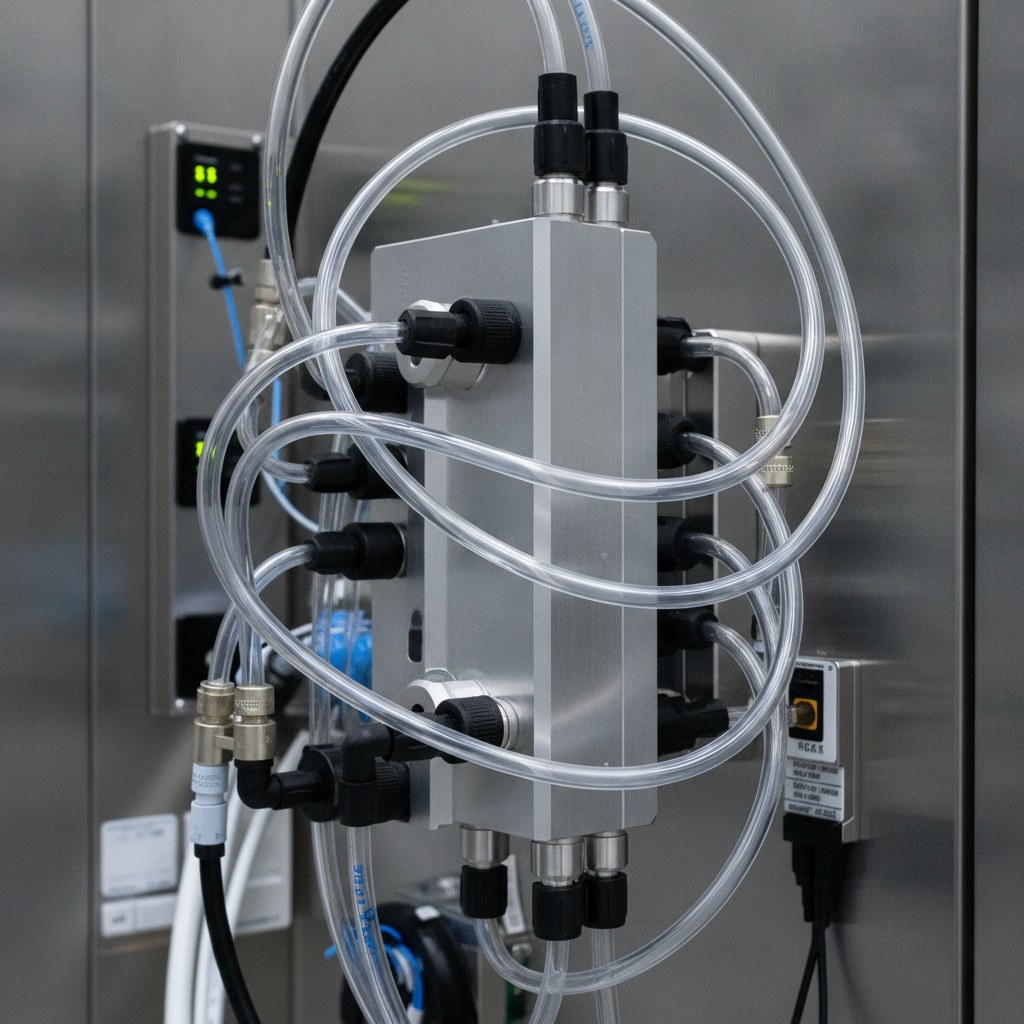
- Flared PFA fittings
- Gripper or compression fittings
- Fusion-welded fittings
- Molded manifolds
- Custom welded assemblies
- Transition fittings
Parker’s Parflare system forms the connection by heating and flaring the PFA tube over a mandrel. Parker states that the design is intended to provide a leak-tight connection with minimal dead volume and can be used in side-loading and vibration applications.
The fitting’s pressure-temperature capability must be checked separately from the tubing. Parker’s published data show that the rating changes with:
- Fitting size
- Nut material
- Temperature
- High-temperature nut configuration
For manifold integration, engineers should consider:
- Number of joints
- Internal dead volume
- Drainability
- Welding or assembly cleanliness
- Thermal expansion
- Mechanical support
- Leak-test method
- Flushing procedure
- Ability to replace individual branches
A low-extractables tube connected using a poorly controlled fitting process does not create a high-purity system.
18. Chemical Compatibility
PFA is selected for semiconductor fluid handling partly because of its broad resistance to acids, bases, oxidizers, and solvents. Nevertheless, chemical compatibility should not be reduced to a simple “compatible” statement.
Actual suitability depends on:
- Chemical identity
- Concentration
- Temperature
- Pressure
- Exposure duration
- Static or flowing service
- Permeation
- Stress
- Mixtures and contaminants
- Cleaning cycles
- Fitting materials
SEMI F57 recognizes the use of polymer components with UPW, acids, bases, oxidizers, salt solutions, and solvents. It also states that defining every possible liquid chemistry and test condition is beyond the standard’s scope. Suppliers and users may therefore need to establish additional chemical-specific test conditions and internal limits.
For a real application, the inquiry should include:
- Chemical name
- Concentration
- Normal temperature
- Maximum temperature
- Normal pressure
- Pressure peaks
- Required purity
- Expected service life
- Cleaning chemistry
- Whether the fluid is hazardous
- Single- or double-containment requirement
F57 qualification answers an important contamination question, but it does not replace application-specific compatibility engineering.
19. SEMI F57 Tubing Supplier Qualification Checklist
Before approving a supplier, buyers should review the product, evidence, manufacturing controls, and application data together.
| Qualification item | Evidence to request |
|---|---|
| Material identity | Resin manufacturer, grade and technical data sheet |
| Virgin material | Written declaration of virgin high-purity PFA |
| Standard revision | SEMI F57-0622 or clearly identified applicable revision |
| Tested object | Resin, finished tubing, fitting or assembly |
| Tested size | OD, ID and wall thickness of the tested product |
| Test laboratory | Laboratory name and accreditation or qualification |
| Test conditions | Sample preparation, 85°C UPW and seven-day extraction details |
| Trace metals | Detection limits, measured results and specification limits |
| Anions | Detection limits, measured results and specification limits |
| TOC | Measured result and applicable limit |
| Particle contribution | SEMI F104 report where required |
| C90 data | Chemical extractable-metal report where required |
| Surface quality | Internal-surface roughness method and results |
| Dimensions | Guaranteed OD, ID, wall, ovality and tolerance |
| Pressure | Pressure-temperature rating for the exact size |
| Bend radius | Static minimum bend radius for the exact configuration |
| Dynamic service | Flex-cycle evidence for moving applications |
| Manufacturing | Cleanroom or controlled-extrusion description |
| Cleaning | Cleaning, rinsing and drying procedure |
| Packaging | End caps, inner bag, outer bag and reel material |
| Traceability | Resin lot, extrusion lot and product marking |
| Certification | CoC and relevant test-report references |
| Change control | Advance notification of material or process changes |
| Chemical use | Application-specific compatibility confirmation |
| Samples | Qualification samples from the intended production process |
A supplier should not receive approval only because its website uses the phrase “SEMI F57 tubing.” Approval should be based on a traceable chain of evidence:
Resin identity → controlled extrusion → finished-product testing → dimensional verification → clean packaging → lot documentation → application validation.
Conclusion
SEMI F57 tubing is best understood as a product-qualification concept, not simply a material category.
The standard helps buyers evaluate whether polymer materials and fluid-handling components can preserve the purity required in semiconductor ultrapure-water and liquid chemical systems. However, a complete tubing decision still requires separate consideration of:
- Finished-product extractables
- Particle contribution
- Chemical compatibility
- Dimensions and tolerances
- Pressure-temperature capability
- Bend and flex behavior
- Fitting design
- Packaging
- Traceability
- Change control
The strongest supplier is not the one making the broadest purity claim. It is the one that can connect every claim to a clearly identified product, test method, result, production lot, and application boundary.
Sources
- SEMI F57 Official Standard Page, Revision History, Scope and Chemical Limitations
- AGC Fluon PFA Applications
- Zeus High-Purity PFA Tubing and Packaging Options
- Saint-Gobain Furon HP PFA 400 Test Report, Metal Extraction, Anion and TOC Data
- CT Associates SEMI F57 Testing
- SEMI F40 Official Page
- SEMI F104 Revision Explanation
- SEMI C90-0725
- Pexco Altaflo 480 UHP PFA Tubing Guide and Traceability
- Furon 400 Series High-Purity PFA Tubing, Traceability, Sizes, Pressure–Temperature Curves and Bend Radius
- Swagelok PFA Flexible Tubing and Ratings
- Parker Parflare PFA Tube Fittings
- Parker Parflare Product Page