
Technical Guide · Source Post 5411
PTFE Fractional, Metric, and AWG Tubing Sizes: What Is the Difference?
When selecting PTFE tubing, buyers often encounter three different size categories: All three describe tubing dimensions, but they do not follow the same naming logic. Fractional and metric tubing systems describe physical dimensions using inches or millimeters. AWG tubing, by contrast, uses a numbered sizing system derived from American Wire Gauge. Understanding the differences between […]
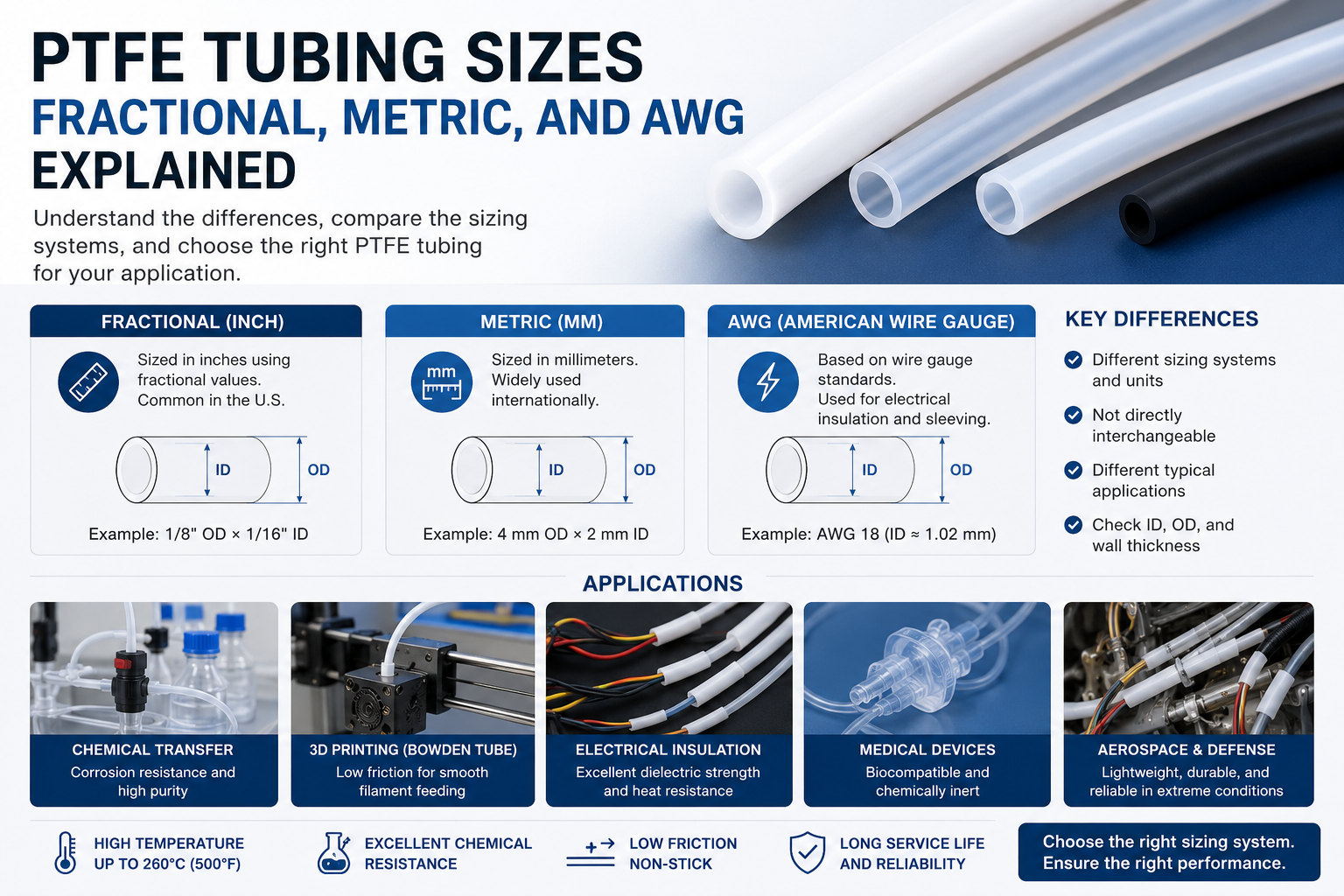
When selecting PTFE tubing, buyers often encounter three different size categories:
- PTFE Fractional Tubing Sizes
- PTFE Metric Tubing Sizes
- PTFE AWG Tubing Sizes
All three describe tubing dimensions, but they do not follow the same naming logic.
Fractional and metric tubing systems describe physical dimensions using inches or millimeters. AWG tubing, by contrast, uses a numbered sizing system derived from American Wire Gauge.
Understanding the differences between these systems helps prevent incorrect selections involving inner diameter, outer diameter, wall thickness, fittings, wires, fibers, and equipment interfaces.
Key Differences Between Fractional, Metric, and AWG Tubing
| Comparison | Fractional Tubing | Metric Tubing | AWG Tubing |
|---|---|---|---|
| Measurement basis | Inches | Millimeters | American Wire Gauge number |
| Typical format | 1/8″, 1/4″, 3/8″ | 2 × 4 mm, 4 × 6 mm | AWG 20, AWG 14 |
| Does the size directly show dimensions? | Usually, but ID or OD must be confirmed | Usually, especially when ID and OD are both shown | No; a size chart is required |
| Size progression | Larger value usually means larger tubing | Larger value means larger tubing | Larger AWG number means smaller wire diameter |
| Typical applications | North American equipment, laboratories, instrumentation | Metric equipment, automation, 3D printing | Wire insulation, cable harnesses, fiber protection |
| Main selection risk | Confusing nominal ID with nominal OD | Treating approximate inch equivalents as interchangeable | Selecting by AWG number without confirming ID, OD, and wall thickness |
The most important distinction is:
Fractional and metric tubing are physical-dimension systems, while AWG tubing is a numbered reference system.
What Is PTFE Fractional Tubing?
PTFE fractional tubing uses inch-based fractional dimensions, such as:
- 1/16″
- 1/8″
- 3/16″
- 1/4″
- 3/8″
- 1/2″
Manufacturers may offer PTFE, FEP, PFA, and ETFE tubing in fractional sizes, often with several wall-thickness options, such as:
- Standard Wall
- Thin Wall
- Lightweight Wall
However, a description such as “1/4-inch PTFE tubing” is not a complete specification.
The 1/4-inch value may refer to:
- Inner diameter;
- Outer diameter;
- A nominal catalog size;
- A fitting-compatible outside diameter.
Some tubing catalogs organize fractional tubing by nominal inner diameter. Industrial compression fittings, on the other hand, are commonly selected according to tubing outside diameter.
Therefore, before purchasing fractional PTFE tubing, the following values should be confirmed:
Nominal ID
Nominal OD
Wall thickness
ID tolerance
OD tolerance
Application Scenario: Laboratory Chemical-Transfer Equipment
Consider a laboratory equipment manufacturer using a compression fitting marked for 1/4-inch tubing.
In this situation, the 1/4-inch value normally refers to the tubing outside diameter accepted by the fitting.
If the buyer mistakenly orders tubing with a 1/4-inch inner diameter, the actual outside diameter may be much larger than 1/4 inch. The tubing will not fit into the compression fitting.
The correct selection process is:
Confirm the fitting’s required tubing OD
↓
Determine the ID required for the target flow
↓
Select an appropriate wall thickness
↓
Verify dimensional tolerances
The primary advantage of fractional tubing in this application is not that inch sizes are inherently superior. It is that they match the existing inch-based equipment interface.
What Is PTFE Metric Tubing?
PTFE metric tubing uses millimeters to describe tubing dimensions.
A common format is:
ID × OD
Examples include:
2 × 4 mm
3 × 4 mm
4 × 6 mm
6 × 8 mm
For a PTFE tube with a 3 mm ID and a 4 mm OD:
Wall thickness
= (OD − ID) ÷ 2
= (4 − 3) ÷ 2
= 0.5 mm
Metric tubing is easy to interpret when the dimensions are clearly labeled. For example, a specification of 2 mm ID × 4 mm OD immediately indicates:
- Inner diameter: 2 mm;
- Outer diameter: 4 mm;
- Wall thickness: 1 mm.
Nevertheless, a formal drawing or purchase order should explicitly state which value is ID and which is OD. A two-number format should not be used without labels because some suppliers may present dimensions differently.
Application Scenario: PTFE Bowden Tubing for 3D Printers
A common PTFE Bowden tube size is:
2 mm ID × 4 mm OD
In this application:
- The 4 mm OD determines whether the tube fits the Bowden coupler;
- The 2 mm ID determines the clearance around 1.75 mm filament;
- The ID tolerance affects filament guidance;
- The wall thickness influences stiffness and bending behavior.
If the OD is correct but the ID is too large, the filament can move excessively inside the tube, reducing retraction accuracy.
If the ID is too small, friction may increase, especially where the tubing bends or where dimensional tolerances are inconsistent.
Metric tubing is therefore widely used in:
- 3D printers;
- European and Asian equipment;
- Pneumatic systems;
- Automation machinery;
- Analytical instruments;
- Medical devices.
What Is PTFE AWG Tubing?
AWG stands for American Wire Gauge.
AWG was originally developed to define the diameter and cross-sectional area of round electrical conductors. The AWG standard directly describes wire sizes, not PTFE tubing dimensions.
Tubing manufacturers use AWG numbers to create tubing size ranges intended for covering wires, fibers, probes, and other small components.
Examples include:
AWG 20 PTFE tubing
AWG 14 PTFE tubing
AWG 8 PTFE tubing
However, the AWG number alone does not provide a complete tubing specification.
A supplier’s AWG tubing chart must still be checked for:
- Nominal ID;
- ID tolerance;
- Wall thickness;
- Nominal OD;
- Wall category.
The same AWG size may be available in several wall constructions:
Standard Wall
Thin Wall
Lightweight Wall
This means AWG 20 tubing does not necessarily have one fixed outer diameter. Its OD depends on the selected wall thickness.
The correct principle is:
Use the AWG number as the starting point, then verify the actual ID, OD, wall thickness, and installation clearance.
Application Scenario: Aerospace Wire-Harness Protection
Suppose an aerospace wire harness contains an AWG 20 insulated wire that requires additional PTFE protection.
The engineer should not simply order “AWG 20 PTFE tubing.”
The following factors must also be considered:
- Whether the wire already has primary insulation;
- The actual maximum diameter of the insulated wire;
- The clearance needed to slide the tubing over the wire;
- Whether the tubing must pass over a terminal or connector;
- The maximum allowable outside diameter;
- The required abrasion and mechanical protection.
Thin-wall tubing may be appropriate where installation space is limited.
Standard-wall tubing may be more suitable where the wire is exposed to abrasion, vibration, sharp edges, or repeated handling.
AWG PTFE tubing is commonly used for:
- Electrical insulation;
- Aerospace wire harnesses;
- Sensor leads;
- Heater leads;
- Fine-wire protection;
- Fiber-optic protection;
- Probe and mandrel covering.
Why Does a Larger AWG Number Mean a Smaller Size?
The AWG system follows an inverse numbering relationship:
Higher AWG number
→ Smaller conductor diameter

Lower AWG number
→ Larger conductor diameter
For example, AWG 24 wire is smaller than AWG 12 wire.
However, this relationship applies to conductor dimensions. It should not be used to calculate a tubing manufacturer’s exact ID or OD.
Tubing dimensions also include:
- Installation clearance;
- Extrusion tolerance;
- Wall thickness;
- Different wall categories.
Therefore, the AWG number should be treated as a lookup reference rather than a complete physical dimension.
Can Fractional and Metric Tubing Be Converted Directly?
Inch values can be converted mathematically into millimeters:
1 inch = 25.4 mm
Examples:
1/4 inch = 6.35 mm
1/8 inch = 3.175 mm
3/8 inch = 9.525 mm
However, mathematical equivalence does not mean two tubing products are interchangeable.
For example, “1/4-inch tubing” may refer to:
- 1/4-inch ID;
- 1/4-inch OD;
- A nominal catalog size;
- A dimension with inch-based tolerances.
Similarly, “6 mm tubing” may refer to a 6 mm OD product or another dimension within a metric catalog series.
Application Scenario: Replacing 1/4-Inch Tubing With 6 mm Tubing
One-quarter inch equals 6.35 mm, so 6 mm tubing may appear to be a close replacement.
The difference is only 0.35 mm, but that difference can be significant in a compression fitting.
Possible consequences include:
- The ferrule cannot grip the tubing correctly;
- Excessive clearance remains inside the fitting;
- The sealing surfaces do not contact evenly;
- The tubing slips under pressure or vibration;
- Leakage occurs.
Therefore, a 6 mm tube should not automatically be used as a substitute for a 1/4-inch tube.
The actual OD, tolerance range, fitting design, sealing method, and pressure conditions must all be checked.
Can AWG Tubing Be Converted to Fractional or Metric Sizes?
AWG tubing cannot be converted by applying a simple multiplication factor to the AWG number.
The correct method is:
Identify the AWG tubing size
↓
Consult the manufacturer’s size chart
↓
Find the actual nominal ID
↓
Confirm wall thickness and OD
↓
Convert the physical dimensions into inches or millimeters
For example, an AWG tubing size may have an ID close to a common fractional or metric dimension, but that does not make the products equivalent.
Two tubes with similar nominal IDs may still differ in:
- OD;
- Wall thickness;
- Tolerance;
- Flexibility;
- Assembly clearance;
- Catalog availability.
Are Fractional and Metric Sizes Mainly for Fluids, While AWG Is Mainly for Wires?
This is generally true, but it is not an absolute rule.
Typical Fractional and Metric Applications
Fractional and metric tubing are commonly used in:
- Chemical-fluid transfer;
- Laboratory equipment;
- Gas-sampling systems;
- Automated machinery;
- Dosing systems;
- Industrial instrumentation;
- Medical flow paths;
- 3D-printer filament guidance.
In fluid applications, the inner diameter directly affects:
- Flow rate;
- Fluid velocity;
- Pressure loss;
- Particle passage;
- Cleaning performance.
The outer diameter affects:
- Fitting compatibility;
- Installation space;
- Clamping;
- Routing;
- Mechanical support.
Typical AWG Applications
AWG tubing is commonly used for:
- Wire insulation;
- Cable harnesses;
- Aerospace wiring;
- Sensor leads;
- Heater leads;
- Fiber optics;
- Fine-wire protection;
- Probe protection.
In these applications, the critical questions are different:
- Can the wire or fiber pass through the tubing?
- Is there enough installation clearance?
- Is the insulation wall thick enough?
- Does the final OD fit within the assembly?
- Is additional abrasion protection required?
AWG tubing can still be used for non-electrical purposes when its actual ID, OD, wall thickness, and tolerance meet the application requirements.
The sizing system does not restrict the tubing to one industry.
What Is the Difference Between Standard Wall, Thin Wall, and Lightweight Wall?
The same nominal fractional or AWG size may be available with different wall thicknesses.
| Wall Category | General Characteristics | Typical Applications |
|---|---|---|
| Standard Wall | Better mechanical protection and dimensional stability | General industrial protection, wire harnesses |
| Thin Wall | Smaller OD and greater flexibility | Space-limited equipment |
| Lightweight Wall | Very small wall thickness and lower weight | Miniature assemblies, lightweight harnesses |
A thinner wall is not automatically better.
Reducing wall thickness can affect:
- Crush resistance;
- Abrasion life;
- Tubing stiffness;
- Burst strength;
- Resistance to installation damage;
- Dimensional stability.
Application Scenario: Compact Sensor Assembly
A compact sensor contains several fine wires that require PTFE insulation, but the internal housing has very limited space.
Standard-wall tubing may produce an OD that is too large to pass through the available channel.
Lightweight-wall tubing may solve the space problem, but it provides less protection against sharp edges and rough handling.
This selection is therefore a design trade-off between:
- Mechanical protection;
- Final OD;
- Flexibility;
- Weight;
- Installation risk.
Wall classification should not be treated as a simple quality grade.
How to Select the Correct PTFE Tubing Size System
1. Identify What Will Pass Through the Tubing
For liquids, gases, particles, or filament, fractional or metric tubing with clearly defined ID and OD is usually the best starting point.
For wires, fibers, small rods, or probes, AWG tubing may provide a more convenient initial reference.
2. Determine Whether ID or OD Controls the Interface
For compression fittings, push-to-connect fittings, and Bowden couplers, OD is normally the critical interface dimension.
For fluid flow, wire insertion, filament movement, or optical-fiber protection, ID is normally the critical dimension.
3. Confirm Wall Thickness and Tolerance
Do not select tubing based only on nominal size.
Two suppliers may both list “1/4-inch PTFE tubing,” but their ID, OD, wall thickness, and tolerances may differ.
4. Match the Tubing System to the Equipment System
Use fractional tubing for inch-based equipment and metric tubing for metric equipment whenever possible.
Avoid replacing one system with a near-equivalent size unless the actual fit has been verified.
5. Test the Tubing in the Final Application
Published dimensions and material properties are useful starting points, but actual performance may also depend on:
- Resin grade;
- Extrusion method;
- Temperature;
- Pressure;
- Bend radius;
- Installation method;
- Fitting design;
- Chemical exposure.
Final validation should be performed under actual operating conditions.
How Should PTFE Tubing Be Specified for Purchasing?
A complete PTFE tubing specification should include more than the size-system name.
Fractional Tubing Specification Example
Material: Virgin PTFE
Sizing system: Fractional
Nominal ID: 1/4 inch
Nominal OD: 5/16 inch
Wall thickness: 1/32 inch
ID tolerance: As specified
OD tolerance: As specified
Color: Natural
Operating medium: Chemical liquid
Connection type: Compression fitting
Metric Tubing Specification Example
Material: Virgin PTFE
Sizing system: Metric
ID: 2.0 mm
OD: 4.0 mm
Wall thickness: 1.0 mm
ID tolerance: ±0.05 mm
OD tolerance: ±0.10 mm
Application: 3D-printer filament guide
AWG Tubing Specification Example
Material: Virgin PTFE
Sizing system: AWG
Wire size: AWG 20
Wall category: Thin Wall
Required minimum ID: As specified
Maximum allowable OD: As specified
Color: Natural
Application: High-temperature wire insulation
A complete request for quotation should normally include:
Material
Sizing system
Nominal ID
Nominal OD
Wall thickness
Dimensional tolerances
Operating temperature
Operating pressure
Fluid or protected object
Fitting or installation method
Required length
Required quantity
Common PTFE Tubing Selection Mistakes
Mistake 1: Specifying Only “1/4-Inch PTFE Tubing”
The problem is that the specification does not indicate whether 1/4 inch refers to ID or OD.
Correct approach:
Specify ID, OD, wall thickness, and tolerances.
Mistake 2: Treating 6 mm as an Automatic Replacement for 1/4 Inch
The problem is that 6 mm and 6.35 mm are not identical, and the fittings may use different tolerances.
Correct approach:
Select the tubing according to the fitting’s actual OD requirement.
Mistake 3: Selecting AWG Tubing Only by Wire Gauge
The problem is that the wire may already have insulation, increasing its actual OD.
Correct approach:
Measure the maximum finished wire diameter and compare it with the tubing’s minimum ID.
Mistake 4: Assuming One AWG Size Has Only One OD
The problem is that Standard Wall, Thin Wall, and Lightweight Wall produce different outside diameters.
Correct approach:
Specify the AWG number and wall category together.
Mistake 5: Confusing Extruded PTFE Tubing With PTFE Heat-Shrink Tubing
Extruded PTFE tubing has fixed ID and OD dimensions.
PTFE heat-shrink tubing must instead be specified using parameters such as:
- Expanded ID;
- Recovered ID;
- Shrink ratio;
- Recovered wall thickness;
- Longitudinal change.
Heat-shrink tubing is commonly used for connector sealing, electrical insulation, environmental protection, and strain relief.
Its sizing logic should not be mixed with ordinary extruded fractional, metric, or AWG tubing.
Conclusion
The main difference between PTFE fractional, metric, and AWG tubing is not the PTFE material itself. The difference is the sizing and selection system.
- Fractional tubing uses inch-based dimensions and is commonly used in North American equipment and inch-based fluid systems.
- Metric tubing uses millimeter dimensions and is widely used in metric machinery, automation systems, analytical equipment, and 3D printers.
- AWG tubing uses a wire-gauge reference system and is commonly used for electrical wires, cable harnesses, fibers, and small-component protection.
Fractional and metric dimensions can be converted mathematically, but approximate equivalents should not automatically be treated as interchangeable products.
AWG tubing must be selected using the manufacturer’s actual dimensional chart, including ID, OD, wall thickness, tolerance, and wall category.
The most reliable purchasing principle is:
Do not purchase PTFE tubing by nominal size name alone. Specify the actual ID, OD, wall thickness, tolerance, and equipment interface.
- Zeus – Fractional Catalog Sizing
Fractional PTFE, FEP, PFA, and ETFE tubing sizes, including Standard, Thin, and Lightweight Wall categories.
URL: https://www.zeusinc.com/products/tubing/fractional-catalog-sizing/ - Zeus – Metric Catalog Sizing
Metric tubing dimensions and wall-thickness series.
URL: https://www.zeusinc.com/products/tubing/metric-catalog-sizing/ - Zeus – American Wire Gauge Catalog Sizing
AWG tubing dimensions and wall categories for fluoropolymer tubing.
URL: https://www.zeusinc.com/products/tubing/american-wire-gauge-awg-catalog-sizing/ - ASTM International – ASTM B258-18(2026)
Standard specification covering nominal diameters and cross-sectional areas of AWG solid round wires.
URL: https://store.astm.org/b0258-18r26.html - Zeus – PTFE Material and Applications
PTFE properties, including low friction, temperature capability, chemical resistance, and industrial applications.
URL: https://www.zeusinc.com/materials/ptfe/ - Zeus – Custom Materials, Sizes, and Colors
Custom tubing capabilities for ID, OD, wall thickness, tolerances, materials, and colors.
URL: https://www.zeusinc.com/products/tubing/custom-materials-sizes-and-colors/ - Swagelok – Tubing and Tube Accessories
Fractional and metric tubing and fitting systems commonly organized by tubing outside diameter.
URL: https://products.swagelok.com/en/all-products/tubing-tube-accessories/tubing/c/811 - TE Connectivity – Heat-Shrink Tubing
Heat-shrink tubing applications involving electrical insulation, sealing, protection, and strain relief.
URL: https://www.te.com/en/products/heat-shrink-tubing.html